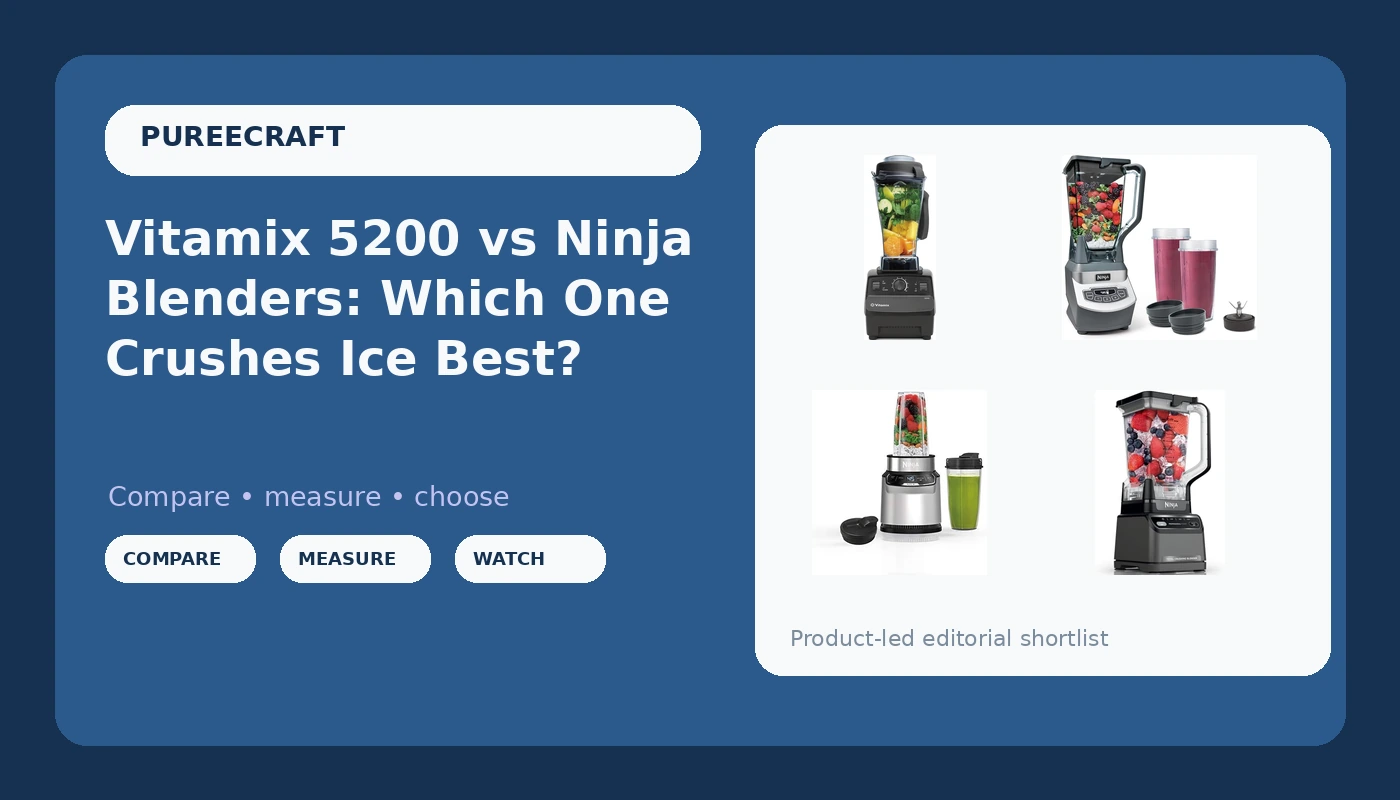
I ran a juice and smoothie bar in San Diego for seven years, and on our busiest day we pushed 400 smoothies through four machines before the lunch rush ended. Since then I've tested blenders for commercial kitchen suppliers, which means I've burned out more motors than most people will own in a lifetime. This Vitamix vs Ninja blender comparison is the version of that conversation I have with friends who text me a photo of a chunky green smoothie and ask what went wrong.
Here's the short answer: the Ninja Professional Blender 2.0 is the best all-around pitcher blender for most homes, the Ninja BL660 is the best pick if you want to-go cups in the box, the Ninja Nutri-Blender Pro is the one to buy if you only ever blend for one, and the Vitamix 5200 is the machine you buy when you're done replacing machines.
But watts are a starting point, not a verdict. Every blender on this list advertises a big number, and only one of them has a jar that pulls a thick blend down into the blades without a fight. That part never makes it onto the box.

Vitamix 5200 Professional-Grade Blender, 64 oz. Container, Black
Ten years on a shop bar, one motor, zero repairs. Best jar geometry here for thick blends
Expensive, tall, and loud. You buy it for the decade, not the week

Ninja BL660 Professional Compact Smoothie & Food Processing Blender, 1100-Watts, 72-oz. Pitcher, (2) 16-oz. To-Go Cups & Spout Lids, Gray
Blade stack keeps frozen fruit moving. Pitcher plus two to-go cups covers a whole household
Plastic pitcher and cups are the wear items. No tamper in the box
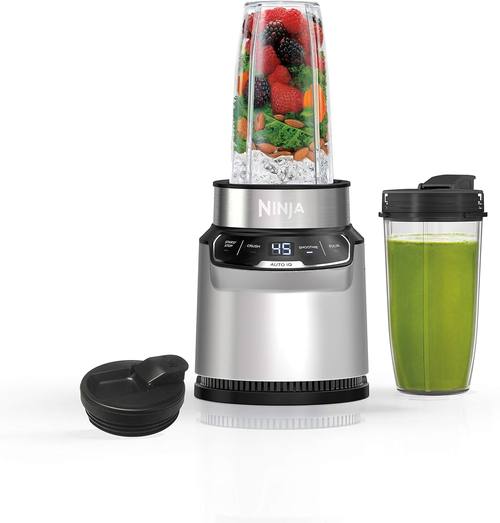
Ninja Nutri-Blender Pro with Auto iQ, 1100PW, (2) 24oz Cups, BN401
Fastest cleanup of the four. Auto-iQ removes the guesswork on timing
Two 24-ounce cups is a breakfast, not a batch. Cups are the consumable part
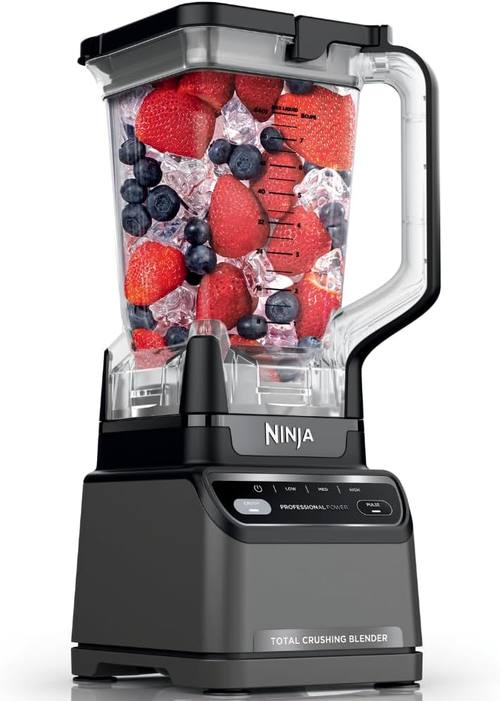
Ninja Professional Blender 2.0, 1200W, Auto-iQ, 72oz Pitcher, BR201AMZ
Best default for a family kitchen. Full pitcher, presets, power that does not strain on frozen fruit
Thick blends still need scraping and staged liquid. No tamper included
Prices and availability were captured from Amazon Creators API and may change.
How I test blenders
Every machine I recommend has to survive what we called the workshift gauntlet at the shop: frozen mango, kale stems, almond butter, and ice by the bucket, blended back to back until the base gets hot or the motor quits. I don't run one smoothie and call it a review. I run enough of them to find the failure point, because that is the only place a blender has anything honest to tell you.
Four things get a machine through my bench:
- Does it crush ice into snow, not gravel? If I can feel grit on my tongue, it failed.
- Does the jar geometry pull thick blends into the blades, or am I standing there fighting with a tamper?
- Does the base walk across the counter at high speed, and does it scream loud enough to wake a neighbor?
- Can I clean it in under a minute without dreading the jar seal?
That last one matters more than people admit. A blender you're scared to put in the dishwasher is a blender you'll stop using, and a blender you stop using is a $400 mistake sitting in a cabinet.
Ice is the test that ends arguments
If it can't crush ice into snow, it can't make a proper smoothie. Full stop. Ice is the cheapest, most consistent stress test there is, because frozen cubes are uniform in a way that frozen fruit never is. When a machine turns ice into fine snow with no chunks left behind, you know the blade stack and jar are doing their jobs together. When it leaves gravel, the motor isn't the problem, the path the food takes to the blades is.
This is where the cheap machines separate themselves, and it's why I don't recommend buying a blender based on a wattage number alone. I've watched lower-powered machines turn a tray of ice into powder while higher-powered ones left chunks spinning in an air pocket. Same wattage claim, completely different result, and the only variable was the jar.
The workhorse: Vitamix 5200
The Vitamix 5200 is the machine I trust. I had one on my shop bar for a decade, one motor, thousands of smoothies, and it never went down for repair. It's the only blender in this comparison with the jar geometry to pull a thick almond butter blend down into the blades without me standing over it, and the tamper is there when I do want to push things along. The tamper is not an accessory. It's the difference between a smoothie and a chunky mess.
Two things to know before you buy. The tall 64-ounce container needs headroom, so measure your cabinet clearance before you commit, because this is not a blender that lives happily under a low shelf. And it's loud. Not broken loud, just commercial loud, the kind of sound that makes you check the time before you blend at 6 a.m.
It is also the most expensive machine here, and that's the honest trade. You are not buying a better smoothie on day one. You're buying the same smoothie on day 3,000, which is a different kind of purchase. If you blend frozen fruit most mornings, the math works. If you blend twice a month, it doesn't.
The value pick: Ninja BL660
Ninja's blade stack design is the reason I recommend this brand to anyone on a budget. It's a set of blades stacked down a central column, and it does the thing cheap blenders usually can't: it keeps frozen fruit moving instead of letting it spin in an air pocket above the blades. The BL660 pairs a 72-ounce pitcher with two 16-ounce to-go cups and spout lids, which means one machine covers a Sunday batch and a Monday commute.
The honest criticism is the plastic. Ninja jars and cups are the parts that fail, not the motors. I've never killed a Ninja motor, and I've cracked more than one cup base in my life. Treat the pitcher like glass, hand wash the cups when you have thirty seconds to spare, and don't torque the seal while the jar is still warm. Do that and you'll get years out of it. Ignore it and you'll be shopping for a replacement pitcher, which is a $30 problem on a machine that costs a fraction of the Vitamix.
There's no tamper in the box, and on a thick nut butter blend you'll miss it. Add liquid in stages instead and you'll get there, just slower.
The cup machine: Ninja Nutri-Blender Pro BN401
I make fun of single-serve cups and I own three of them, which tells you how that argument usually ends in my kitchen. The Nutri-Blender Pro is the one I'd hand to someone who blends exactly one smoothie a day and does not want to wash a 72-ounce pitcher to get it. Auto-iQ takes the timing decision away from you, which sounds like a gimmick until you're half awake at six in the morning and don't want to count pulses.
The trade-off is capacity and cup life. Two 24-ounce cups is a great breakfast and a useless batch of soup. The cups are also the wear item in any single-serve system, so treat them accordingly and don't send a hot jar straight from the dishwasher into a frozen blend. If your household blends for two or more people at once, skip this one and buy a pitcher machine. Single-serve cups are the graveyard of good intentions, and I say that as someone who keeps buying them.
The new pitcher: Ninja Professional Blender 2.0 BR201AMZ
This is the newest of the four, with 1200 watts, Auto-iQ presets, and a 72-ounce pitcher, and it's the one I'd call the best default for a family kitchen. It sits in the sweet spot between the BL660's flexibility and the Vitamix's price: a full-size pitcher, enough power that the motor doesn't strain on frozen fruit, and preset programs that keep you from over-blending a sauce into soup.
What it doesn't do is solve jar geometry the way the Vitamix does. Thick blends need scraping and a pause, and you'll want to add liquid in stages rather than dumping everything in at once. That's normal behavior at this price, and it's not a flaw so much as the line between a home machine and a commercial one. If I were starting over with a normal blender budget, this is the one I'd buy first.
Where each one loses
Vitamix 5200: price, height, and noise. It is the hardest of the four to store and the most expensive to buy, and neither of those is a blending flaw. They're ownership flaws, and they're real.
Ninja BL660: the plastic pitcher and cups are the weak points, and 72 ounces is more capacity than one person needs. It's a household machine, not a solo machine.
Ninja Nutri-Blender Pro BN401: capacity, plus the cups are the consumable part of the system. Buy it knowing you'll replace cups before you replace the base.
Ninja Professional Blender 2.0 BR201AMZ: no tamper in the box, and it demands liquid discipline on very thick blends. Rush it and you'll be scraping.
Cleaning, seals, and the dishwasher question
The seal at the base of a jar is where cheap blenders go to die. It's the spot that collects grit, the spot that gets torqued when you screw the base on too tight, and the spot that starts leaking right around the time you've decided you like the machine. Wash jars promptly, don't let nut butter dry in the seal ring overnight, and never put a hot jar into cold water.
Dishwasher-safe parts are the quiet spec nobody advertises. If the jar, lid, and cups can go in the dishwasher, you'll use the blender on a Tuesday night after dinner. If they can't, it becomes a weekend appliance, and weekend appliances get sold at garage sales. I preach dishwasher-safe jars and I still hand wash my Vitamix like it's heirloom china, so do as I say here and not as I do.
Should you buy the Vitamix or the Ninja?
Buy the Vitamix 5200 if you blend frozen fruit, greens, or nut butter most days and you want to stop thinking about blenders. It's a commercial-grade machine in home appliance clothing, and a decade of shop use with one motor and no repairs is the entire review.
Buy a Ninja if you want the job done for a fraction of the cost and you accept that the jar is the part with a lifespan. The Ninja Professional Blender 2.0 is the best all-rounder, the BL660 is the best value if you want to-go cups included, and the Nutri-Blender Pro is the right call for one person, one cup, one habit.
Skip all four if what you actually want is a quiet blender. None of these is quiet, and I'd rather tell you that now than have you find out at 6 a.m. with a neighbor's bedroom on the other side of the wall.
What I'm testing next
I'm partway through a nine-machine run of the same 50-smoothie gauntlet I used at the shop, with a stopwatch and a tray of ice, and two questions keep coming back. First, do the newest Auto-iQ presets hold up once a pitcher has a season of scratches on it? Second, does any sub-$150 jar survive a full year of dishwasher cycles without a seal leak? I'll report back when the machines stop being polite about it.