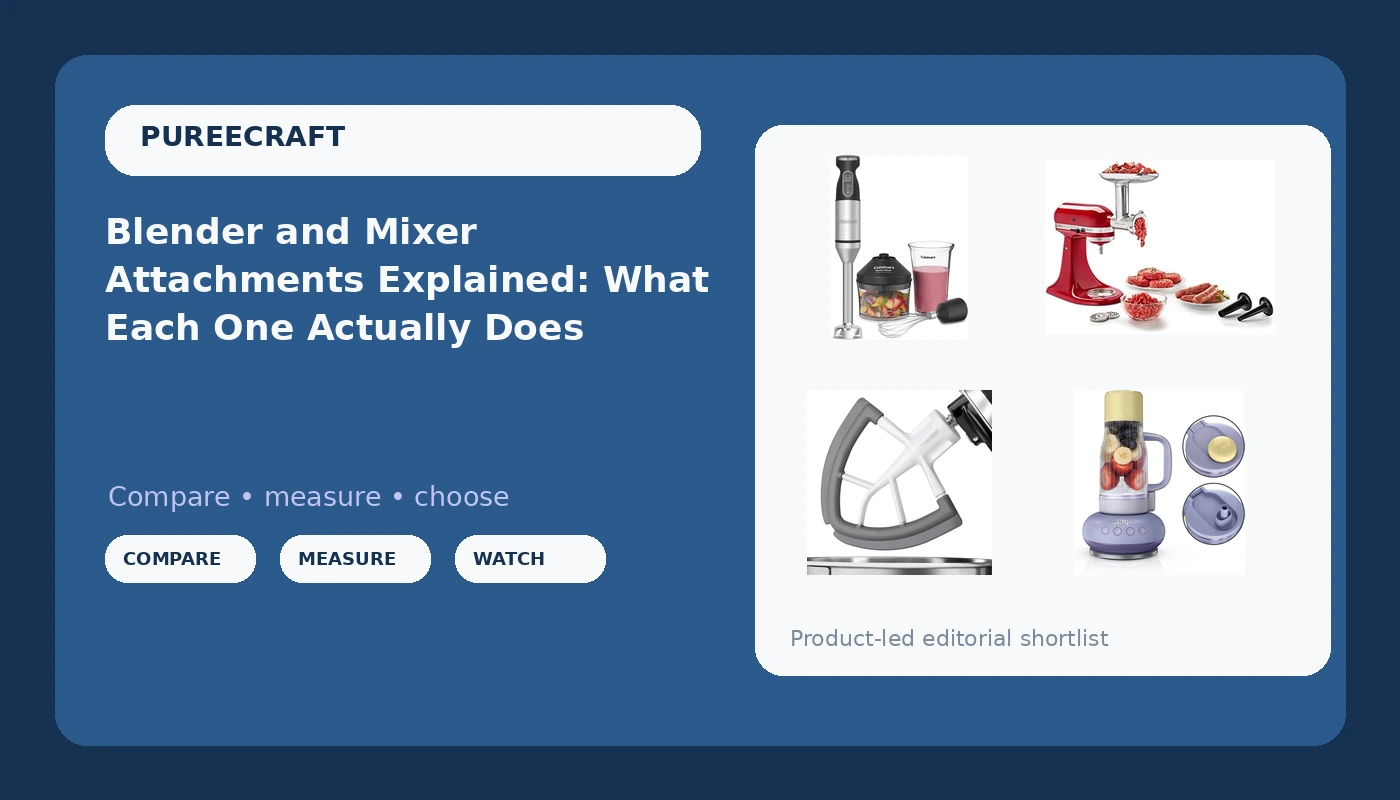
If you have ever stood in the small-appliance aisle trying to work out whether you need a personal blender, an immersion wand, a stand mixer attachment, or simply a better beater, the confusion is not a failure on your part. Blender and mixer attachments are marketed as though each one were a complete kitchen, when each is really a narrow tool built around a single job. The useful question is not which of them wins. It is which job you are hiring for, and whether the equipment already sitting on your counter can be extended instead of replaced. What follows is a straight look at four specific options, what each is designed to do, and the point at which each one stops being the right answer.
Related: How Jar Geometry Decides What a Blender Can Handle →
Quick answer
These four products do not compete with each other, so there is no single winner to crown. A personal blender is built for one serving at a time, blended in the cup you drink from. An immersion blender is built for food that is already in a pot, which is why it matters most for soup and sauce. A grinder attachment is built to extend a stand mixer you already own into meat and hard-ingredient work. A flex edge beater is built to replace the flat beater that came with the mixer so the bowl gets scraped while it turns. Match the tool to the job rather than ranking the tools against one another.
Four useful options
| Model | Best fit | What stands out |
|---|---|---|
| Ninja BlendBOSS Personal Blender, 26oz Tumbler, 1200PW, Purple, DB351PR | One-person smoothies and shakes | A 26 oz tumbler that serves as both blending cup and drinking cup |
| Cuisinart CSB-179 Smart Stick Variable Speed Hand Blender, Stainless Steel | Soup, sauce, and puree made in the pot | Variable speed control on a stainless steel shaft |
| KitchenAid KSMMGA Food Grinder Attachment for All KitchenAid Stand Mixers | Grinding meat and hard ingredients | Runs off a stand mixer's hub instead of its own motor |
| Flex Edge Beater for KitchenAid,Mixer Attachement Compatible With KitchenAid,Mixer Accessory,Fits Tilt-Head Stand Mixer Bowls For 4.5-5 Quart Bowls,Beater With Silicone Edges,Grey | Creaming, mixing, and bowl scraping | Silicone edges that sweep the bowl wall as the beater turns |
The single-serve pick: Ninja BlendBOSS Personal Blender, 26oz Tumbler, 1200PW, Purple, DB351PR
The trade-off with any single-serve machine is batch size. A 26 oz cup is one drink, which is perfect on a weekday morning and frustrating when four people want breakfast at the same time. Cup-based blenders also put wear on the cup itself rather than on a separate pitcher, so the cup becomes a consumable part of the system. Before buying, confirm two things: whether the cup and blade assembly are listed as dishwasher-safe, and whether replacement cups are sold on their own. A personal blender with no replacement cups available is a personal blender with a countdown clock attached to it.
The in-the-pot pick: Cuisinart CSB-179 Smart Stick Variable Speed Hand Blender, Stainless Steel
Variable speed is the detail that separates a useful immersion blender from a splashing one, because it lets you start slow and ramp up instead of hitting a pot of hot liquid at full power. The honest limitation is scope. An immersion blender is not a substitute for a heavy countertop machine when you are working with frozen fruit by the bag, dense nut butters, or large ice loads. It is also not designed for batch work: it blends what is in front of it, one pot at a time. Where it earns its place is soup season, pan sauces, salad dressings, and small purees for a baby or a single sauce, all of which are jobs a full-size pitcher blender handles awkwardly.
The mixer-powered pick: KitchenAid KSMMGA Food Grinder Attachment for All KitchenAid Stand Mixers
The entire value of this attachment depends on a condition: you have to already own a compatible KitchenAid stand mixer with a working attachment hub. If you do not, the math changes completely, because you are now buying a mixer and an attachment to get a grinder. If you do own one, the appeal is counter space and storage. A dedicated grinder is a bulky single-purpose appliance that lives in a cabinet eleven months a year. An attachment that shares a motor you already paid for is a much smaller commitment, and it comes apart for cleaning, which matters more than any spec sheet on a tool that touches raw meat.
The bowl-scraping pick: Flex Edge Beater for KitchenAid,Mixer Attachement Compatible With KitchenAid,Mixer Accessory,Fits Tilt-Head Stand Mixer Bowls For 4.5-5 Quart Bowls,Beater With Silicone Edges,Grey
Two compatibility checks matter here, and both are easy to get wrong. First, tilt-head versus bowl-lift: this beater is listed for tilt-head bowls, so a bowl-lift mixer is the wrong machine for it. Second, bowl size. A 4.5 to 5 quart bowl is a specific range, and a beater that does not reach the bowl wall cannot scrape anything. Silicone edges are also a wear item by nature, so treat this as a part with a lifespan rather than a permanent upgrade. What you get in exchange is fewer interruptions during creaming and frosting, which is the difference between a batter that comes together evenly and one with a stripe of unmixed butter stuck to the side.
Prices and availability may change. Product images, names, and retailer links are matched to verified listings. No current price, rating, stock status, or measured result is stated here without current evidence.
Watts, jar geometry, and blade design: what actually decides performance
Wattage is the number shoppers reach for first and the one that explains the least. A motor rating tells you how much power the machine can draw, not how effectively that power reaches the food. Two blenders with identical wattage ratings can behave completely differently depending on jar shape and blade placement.
Jar geometry is the part nobody prints on the box. A jar that tapers toward the blades funnels ingredients down into the cutting path on its own. A jar with wide shoulders and a flat bottom lets thick mixtures sit above the blades and spin in place, which is exactly the situation where you find yourself stopping the machine to push food down with a spatula. This is why a tamper exists on thick-blend machines, and why a tamper-free design on a machine built for nut butters and frozen fruit is a design flaw rather than a feature.
Blade design follows the same logic. Stacked blade assemblies with multiple levels catch ingredients at different heights in the jar, which helps with ice and frozen fruit. Flat two-blade assemblies work fine for liquids and struggle with anything solid. When you read a product description, ask what the jar does to move food downward. If the answer is nothing, the wattage number is doing marketing work rather than mechanical work.
What a stand mixer attachment can and cannot do
Stand mixer attachments work on a simple principle: the mixer already has a motor and a hub, so attachments borrow both. That is efficient and it is also the source of every limitation. An attachment inherits the mixer's torque, its speed range, and its physical mounting point, and it cannot exceed any of them.
The practical consequences are worth spelling out. Attachments are generally not designed for continuous heavy load the way a dedicated appliance with its own cooling and its own gearbox is. They also depend on a clean, undamaged hub, since a worn hub connection transfers vibration into the attachment instead of power. And compatibility is model-specific in ways that are easy to miss: hub design, bowl shape, and bowl size all vary across mixer lines, which is why a beater listed for tilt-head 4.5 to 5 quart bowls is not a universal part.
That is not an argument against attachments. It is an argument for checking the fit before you buy, because an attachment that does not seat properly is worse than no attachment at all. If you are unsure, the reliable move is to identify your exact mixer model first, then match the attachment's listed compatibility to it.
- Write down the three things you blend or mix most often in a normal week.
- Check what you already own, including whether your stand mixer has a usable attachment hub.
- Decide whether you need batch capacity or single servings, because that choice eliminates half the options immediately.
- Confirm physical compatibility before buying: bowl size, tilt-head versus bowl-lift, hub type, and cup availability.
- Trace the cleaning path, since a tool that is annoying to wash is a tool that ends up in the back of a cabinet.
Practical guidance before you buy
- Measure your cabinet clearance, because a personal blender on a counter is useful and the same blender in a box is not.
- Confirm which parts are listed as dishwasher-safe, and check whether replacement cups, gaskets, or silicone edges are sold separately.
- For anything that goes in a pot, keep the blending head fully submerged and work off the heat where you can.
- For mixer attachments, verify your exact model against the listing's compatibility language rather than assuming all KitchenAid mixers are identical.
- Expect consumable parts. Cups, gaskets, and silicone edges all wear out, and a machine with no replacement parts available has a shorter useful life than its motor suggests.
Which option should you choose?
Choose the Ninja BlendBOSS Personal Blender, 26oz Tumbler, 1200PW, Purple, DB351PR when you make one drink at a time and want to drink from the same cup you blended in. Choose the Cuisinart CSB-179 Smart Stick Variable Speed Hand Blender, Stainless Steel when most of your blending happens in a pot of soup or a pan of sauce and you want speed control in your hand. Choose the KitchenAid KSMMGA Food Grinder Attachment for All KitchenAid Stand Mixers when you already own a compatible KitchenAid stand mixer and want grinding capability without a second motor on the counter. Choose the Flex Edge Beater for KitchenAid,Mixer Attachement Compatible With KitchenAid,Mixer Accessory,Fits Tilt-Head Stand Mixer Bowls For 4.5-5 Quart Bowls,Beater With Silicone Edges,Grey when your mixer's flat beater leaves batter clinging to the bowl wall.
One caveat applies across all four. None of these descriptions tell you how a machine behaves under a heavy load, how loud it runs, or how long its parts last. Those answers come from the jar and blade design, the cleaning routine, and the availability of replacement parts, not from a wattage figure. Treat the listings as a starting point and the compatibility details as the deciding factor.
The bottom line
Blender and mixer attachments are narrow tools, and the fastest way to buy the wrong one is to shop for the most impressive spec instead of the job you actually do. A personal blender solves single servings. An immersion blender solves anything already in a pot. A grinder attachment solves meat and hard ingredients for people who already own the mixer that powers it. A flex edge beater solves bowl scraping on a specific class of mixer bowl. Identify the job first, verify compatibility second, and the choice becomes obvious rather than overwhelming.