Blender jars and personal blenders get marketed as if they were the same purchase, and that is where most shopping mistakes begin. A personal blender is a cup and a motor: you blend one serving and drink from the vessel. A full-size jar is a batch machine: you blend for two people, or for a week of soup. A replacement container is neither of those things, because it does nothing at all unless you already own a base it was built to fit. Getting the format wrong is why a perfectly good motor ends up parked in a cabinet behind the mixing bowls. The useful question is not which machine is strongest on paper. It is which format matches the volume you blend, the ingredients you actually use, and the cleanup you are willing to do at 6:45 in the morning.
Related: How to Crush Ice Without Stressing Your Motor →
Quick answer
Match the format to the job. If you blend one smoothie at a time and want to drink straight from the cup, a personal blender is the right shape of machine. If you blend for more than one person, cook soups, or make nut butter, a full-size jar on a countertop base makes more sense. If you already own a compatible base, buying a container instead of an entire machine is the cheaper route, but only when the listing names your exact model. Wattage figures are a starting point rather than a verdict: jar geometry, blade design, and how easily food falls back into the blade path decide what actually comes out smooth.
Four useful options
| Model | Best fit | What stands out |
|---|---|---|
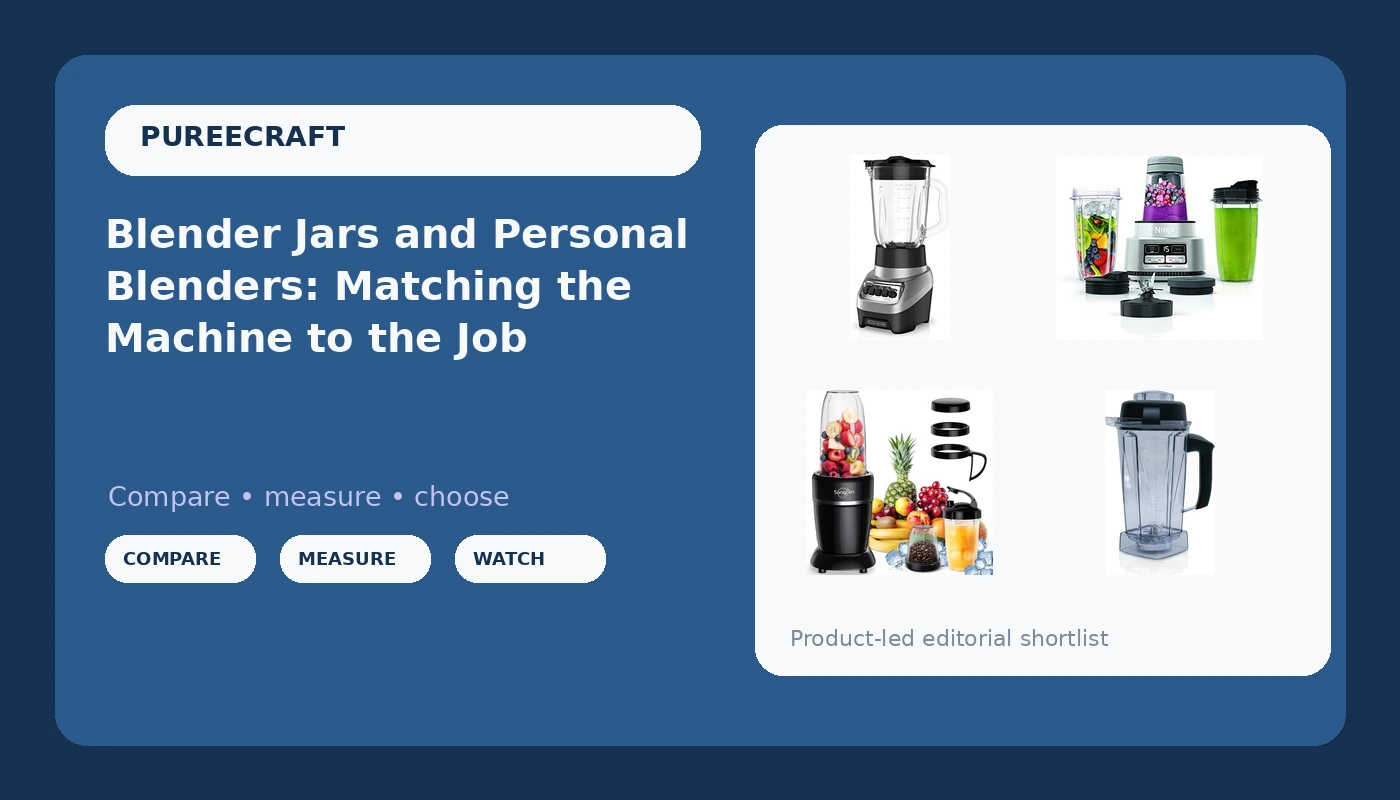
| BLACK+DECKER PowerCrush Multi-Function Blender with 6-Cup Glass Jar, 4 Speed Settings, Silver | Countertop batches for one or two people | 6-cup glass jar and four manual speed settings |
| Ninja Foodi Personal Blender & Smoothie Bowl Maker, 1200PW, SS101 | Single servings plus thicker, spoonable blends | Personal blender paired with a smoothie bowl maker function |
| Sangcon 1000W Powerful Personal Smoothies Blender Frozen Fruit Ice Crushing | Single servings built around frozen ingredients | 1000W motor rating in a personal, cup-style format |
| Pure Realm 64oz blender Container for vitamix 5200, 6300, E310, VM0101 etc | Replacing or adding a jar for a base you already own | 64oz container listed for several Vitamix models |
All-purpose countertop machine: BLACK+DECKER PowerCrush Multi-Function Blender with 6-Cup Glass Jar, 4 Speed Settings, Silver
The glass jar is the detail that matters most here, and it is the one buyers tend to overlook. Glass does not hold onto the smell of garlic, curry, or ginger the way plastic can, and it takes hot soapy water without warping or clouding. The trade-off is weight: a 6-cup glass jar is heavier to lift, heavier to wash, and the part most likely to break if it meets a tile floor. Four speed settings give you a manual range rather than a set of one-touch programs, which suits cooks who want to pulse and adjust as they go. On a countertop machine in this class, very thick blends such as frozen fruit and nut butter ask for patience and a spatula, because there is no tamper in the box and the jar shape has to do all the work of pulling food down into the blade path.
Personal blender with a bowl function: Ninja Foodi Personal Blender & Smoothie Bowl Maker, 1200PW, SS101
Personal blenders are single-serving machines, and that is the honest limit of the format. This one pairs a cup with a smoothie bowl maker, which targets blends thick enough to eat rather than sip. That is a genuinely different job from thin green juice: thick blends stall more often, so how the cup funnels ingredients back toward the blades matters as much as the motor rating printed on the box. The 1200PW figure describes the motor rating the manufacturer lists, not the texture you will get, because texture depends on what you load in and in what order. One cup also means one trip through the machine, so if two people in the house want smoothies at the same time, someone is waiting.
Budget frozen-fruit blender: Sangcon 1000W Powerful Personal Smoothies Blender Frozen Fruit Ice Crushing
A 1000W personal blender is aimed at the person whose main ingredient comes out of the freezer. Frozen fruit and ice are the two loads that separate a capable motor from an optimistic one, and a single-serve cup makes both harder, because there is less volume for ingredients to move around in. Blade geometry and jar shape decide whether frozen chunks get pulled into the blades or simply spin in place above them. Cup-style machines also ask you to commit to one serving at a time, and the cups themselves are usually the first part to wear out on any personal blender, so cup availability and replacement cost belong in the decision rather than in the fine print afterward.
Replacement container: Pure Realm 64oz blender Container for vitamix 5200, 6300, E310, VM0101 etc
This is the one item here that does not blend anything on its own. It is a 64oz container listed as compatible with Vitamix 5200, 6300, E310, VM0101 and similar bases, which means it is for owners who already have a motor base and either cracked a jar or want a second one. Before buying any container, find the exact model number on the bottom of your base and check it against the listing, because compatibility statements are model-specific and a container that does not seat correctly on a base is not a bargain at any price. A spare jar is also the simplest way to stop washing the same container twice a day, which is the practical reason most people buy one.
Prices and availability may change. Product images, names, and retailer links must be matched by verified ASIN. Do not state a current price, rating, stock status, or measured result without current evidence.
Jar geometry, blade design, and what watts really mean
Wattage is the number shoppers compare and the number that explains the least. A motor rating describes electrical power draw, not blade speed, not torque at low speed, and not how well a jar pulls food down into the blades. Two machines with identical ratings can behave completely differently on the same frozen mango, because the variable that matters is whether the ingredients keep circulating.
Jar geometry is that variable. Wide, straight-sided jars let thick blends climb the walls and sit there, out of reach of the blades. Jars that taper toward the blade, or that have internal ribs to knock food back toward the center, keep the load moving without help. This is the real dividing line between an inexpensive blender and an expensive one, and it is why a lower-rated machine with good jar design can outperform a higher-rated machine with a bad one.
Blade design works with the jar, not against it. Stacked blade assemblies create several cutting zones at different heights, which helps when the jar is loaded unevenly. Flat two-blade setups rely almost entirely on the jar funneling food downward. Neither is automatically better, but a stacked assembly in a poorly shaped jar still leaves chunks spinning on top.
The tamper deserves a mention because it is the honest answer to thick blends. When a jar cannot pull a heavy mixture down, a tamper pushes it into the blade path without stopping the machine. Machines designed for thick work usually include one, and machines that do not include one are quietly telling you what they expect you to blend.
Jar material is the last piece. Glass resists odors and scratches, takes hot water, and is heavier and breakable. Plastic and copolyester jars are lighter and more forgiving on the counter, but they scratch over time, and scratched plastic holds onto smells and stains. If the jar is not dishwasher safe, that is a signal about how often it will actually get used.
How to judge a blender before you buy
- Start with the volume you blend in one session, not the volume you imagine blending. One smoothie means a cup. Two or more servings, soup, or nut butter means a full-size jar.
- Confirm what you are actually buying. A container listing is not a machine listing, and a machine listing is not a guarantee that the jar is replaceable later.
- Check compatibility by exact model number if you already own a base, and read the compatibility line as a list of specific models rather than a general promise.
- Ask what happens on the hardest thing you blend. Frozen fruit and ice demand blade geometry and circulation; thick nut butters demand either a tamper or a jar that funnels well.
- Factor in cleanup and cup replacement before you commit, because the part that wears out first on a personal blender is usually the cup, not the motor.
Practical guidance for everyday blending
- Load frozen and hard ingredients first, soft ingredients next, and liquid last, so the blades start in a pocket of liquid rather than on bare ice.
- Start on a low speed to break up frozen chunks, then move up, instead of hitting full power on a solid block of fruit.
- Give thick blends time and short pulses rather than one long run, and stop to scrape down when the mixture stops circulating.
- Rinse the jar immediately after use. A thirty-second rinse now beats a ten-minute soak later, and it is the single habit that keeps a blender in rotation.
- Treat the jar, the lid, and the cups as consumables. Check that replacements are available before you buy a machine whose only vessel is a proprietary cup.
Which option should you choose?
Choose the BLACK+DECKER PowerCrush Multi-Function Blender with 6-Cup Glass Jar, 4 Speed Settings, Silver when you blend for one or two people at a countertop station and want a glass jar with manual speed control. Choose the Ninja Foodi Personal Blender & Smoothie Bowl Maker, 1200PW, SS101 when your routine is a single serving, and when thicker, spoonable blends are part of what you make. Choose the Sangcon 1000W Powerful Personal Smoothies Blender Frozen Fruit Ice Crushing when frozen fruit and ice are your main ingredients and you want that work done in a cup. Choose the Pure Realm 64oz blender Container for vitamix 5200, 6300, E310, VM0101 etc when you already own a compatible base and need a container rather than another machine.
None of these choices can be settled by a spec sheet alone. Motor ratings, cup sizes, and capacity figures are manufacturer-stated, and the texture you get depends on what you load and in what order. If you already own a base, verify the model number against the container listing before ordering, and if you are buying your first blender, decide the serving size first and the wattage second.
The bottom line
The format decides more than the specification. A personal blender earns its place when you genuinely blend one serving at a time and want to carry it out the door. A full-size jar earns its place when you blend in batches, cook, or make thick spreads that need room to move. A replacement container is the cheapest fix available, but only for the specific bases it was built to fit. Work backward from the volume you blend and the hardest ingredient you use, and the choice between these four stops being a comparison of numbers and starts being a question about your kitchen.