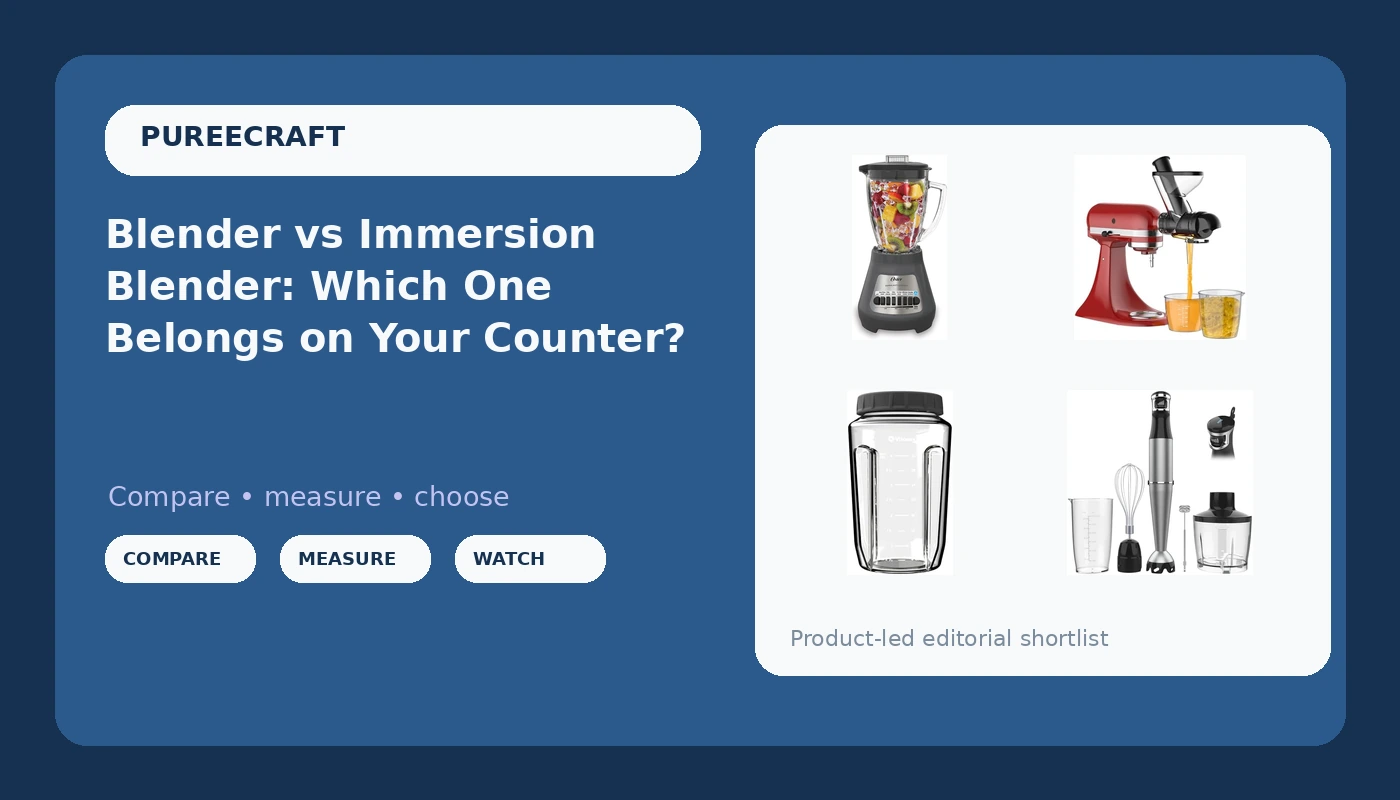
Search for a blender and you will get results for at least four different kinds of appliance. That is the trap. A countertop blender, a juicer attachment that runs off a stand mixer, an immersion blending jar, and a handheld immersion blender all sit in the same aisle and the same search results, but they do different jobs, and buying the wrong one is how a kitchen ends up with a cupboard full of gadgets nobody plugs in. The blender vs immersion blender decision is really a question about what you make most often, how much counter space you are willing to give up permanently, and whether you already own a stand mixer that can take on part of the work. Get those three answers straight and the shopping list gets short fast.
Related: How to Choose a Blender That Actually Crushes Ice →
Quick answer
If you want one appliance that handles frozen fruit, ice, and full-size batches, start with a countertop blender, and the Oster Classic Series 8-Speed Blender with 6-Cup Glass Jar is the straightforward entry point. If you already own a KitchenAid stand mixer and your goal is juice rather than smoothies, the GVODE Masticating Juicer Attachment adds that job to a machine you already have. If you mostly blend soups, sauces, and small batches directly in the pot, a corded handheld like the Turelar Immersion Blender covers it. The Vitamix Immersion Blending Jar is not a motor at all; it is a 32 oz vessel for people who already blend with a compatible immersion motor. None of these is universally better than the others, because each one removes a different bottleneck.
Four useful options
| Model | Best fit | What stands out |
|---|---|---|
| Oster Classic Series 8-Speed Blender with 6-Cup Glass Jar, Gray | Everyday countertop blending in batches | Eight speed settings and a six-cup glass jar |
| GVODE Masticating Juicer Attachment for KitchenAid Mixer, Dual Feed Chute | Turning an existing stand mixer into a juicer | Masticating design with a dual feed chute, built as a mixer attachment |
| Vitamix Immersion Blending Jar, 32 oz | Blending into a dedicated vessel with a compatible immersion motor | 32 oz BPA-free Tritan jar that is dishwasher safe |
| Turelar Immersion Blender Handheld Corded, 1100W 5 in 1 Hand Blender Set | Soups, sauces, and small batches blended in the pot | 1100W corded motor sold as a 5-in-1 set |
The countertop starting point: Oster Classic Series 8-Speed Blender with 6-Cup Glass Jar
This is the category most people should look at first, and also the category where the trade-offs are easiest to understand. A glass jar is heavier than a plastic pitcher, and you feel that every time you lift it off the base and every time you wash it. In exchange you get a vessel that resists scratching and staining, which is exactly the kind of thing that keeps a blender in rotation instead of on a shelf. Eight speeds give you a range from coarse chopping to a smoother blend, though the number of speeds is a control feature, not a performance guarantee. What actually determines how well a countertop blender handles a thick blend is how the jar shape funnels food down into the blades, and that is covered further below.
The mixer attachment: GVODE Masticating Juicer Attachment for KitchenAid Mixer, Dual Feed Chute
The trade-off here is the mirror image of the countertop blender. You are not buying a machine that makes smoothies. You are buying a juicing function for a mixer you already own, and that only works if the mixer is actually in your kitchen and compatible. Slow juicing is exactly that, slow, so a tall pile of carrots takes real time to work through, and an attachment like this has more separate parts to rinse than a blender jar does. What it buys you is juice without a dedicated juicer footprint, plus a dual feed chute that lets you keep feeding produce without stopping to reload a single narrow tube. If your household drinks juice and already has the mixer, this is a far more efficient use of space than adding another base to the counter.
The vessel, not the motor: Vitamix Immersion Blending Jar, 32 oz
The value of a jar like this is narrower than the value of a blender, and that is fine as long as you know it going in. If you already use an immersion blender regularly, a proper deep vessel solves a real daily annoyance: shallow containers let food climb the walls and spray, while a tall narrow jar keeps the blade submerged and the contents contained. If you do not already own an immersion motor, this purchase makes no sense on its own. Dishwasher safe and BPA-free Tritan are practical details rather than marketing flourishes, because a jar you have to hand wash with a brush is a jar that slowly stops getting used.
The handheld: Turelar Immersion Blender Handheld Corded, 1100W 5 in 1 Hand Blender Set
The case for a handheld is not that it replaces a countertop blender. It does not. A handheld is the wrong tool for a thick frozen smoothie with ice, because there is no jar geometry pulling the contents down into the blade path, and you end up chasing ingredients around the pot. Where it wins is soup, sauce, and anything you would otherwise have to transfer, blend in batches, and pour back. Blending tomato soup directly in the pot means one fewer vessel to wash and no risk of a hot liquid eruption in a sealed jar. The cord is the limitation to accept: you are tethered to an outlet, which matters more in a small kitchen than people expect.
Prices and availability may change. Product images, names, and retailer links must be matched by verified ASIN. Do not state a current price, rating, stock status, or measured result without current evidence.
What wattage does and does not tell you
Wattage is the number shoppers reach for first, and it is the number that explains the least on its own. A watt rating describes how much power a motor can draw, not how much torque arrives at the blade, and not how fast the blade spins under load. Two machines with the same rating can behave completely differently once frozen fruit hits the blades, because a motor that bogs down and stalls is a motor that is not delivering its rated draw at that moment.
This is why a bigger number on the box does not automatically mean a better blend. The rest of the system has to cooperate. The blade has to be sharp and shaped to create a downward pull. The jar has to be narrow enough at the bottom that food cannot sit in a dead zone outside the blade path. The lid has to seal well enough that you can run the machine without holding it down. When any one of those pieces fails, extra watts do not rescue the blend; they just get absorbed as heat and noise.
The practical takeaway is to treat wattage as a floor, not a ranking. It tells you roughly what class of work a motor is built for. It does not tell you whether the machine will handle nut butter, whether the base will creep across the counter, or whether the jar seal will survive a year of dishwasher cycles. Those answers come from the design around the motor, and from what other buyers report over time.
Jar geometry, blade shape, and why thick blends stall
If you take one idea away from this explainer, make it jar geometry. The shape of the container is what keeps ingredients circulating back into the blades, and it is the single biggest difference between a machine that makes a smooth puree and one that leaves chunks stuck to the wall while the blade spins freely in a pocket of air.
A good blending jar is narrower at the bottom than at the top, which lets gravity do part of the work. As the blade spins, it creates a vortex that pulls the mixture down through the center and pushes it back up the sides. In a wide, flat-bottomed container that circulation never establishes, and thick mixtures like nut butter or frozen fruit with little liquid simply sit there. This is also why a tamper exists on machines built for thick blends: when the vortex cannot form because the mixture is too stiff, something has to physically push the food into the blade path.
Blade design matters in the same direction. More blades is not automatically better; blade angle and sharpness determine whether the blade pulls food down or just throws it outward. The materials matter too. A glass jar resists scratching and staining over years of use, which is why a six-cup glass jar shows up on a classic countertop machine. Tritan, used in the immersion jar here, is a rigid BPA-free plastic chosen for clarity and impact resistance rather than for looks.
Here is a short version of the decision process:
- Write down what you make most often: frozen smoothies, juice, or soup.
- Decide how much permanent counter space you are willing to surrender.
- Inventory what you already own, especially a stand mixer that could host an attachment.
- Check the jar itself: capacity, material, and whether it is dishwasher safe.
- Decide whether you need a corded machine with full power or a cordless one with more freedom.
Keeping the setup usable
- Match the tool to the batch size you actually make, not the batch size you imagine making.
- If frozen fruit and ice are a daily habit, prioritize a countertop jar over a handheld.
- If soup is the goal, a handheld lets you blend in the pot and skip the transfer step entirely.
- Confirm the jar is dishwasher safe before buying, because hand washing is what kills daily use.
- If you are considering the juicer attachment, verify it fits your specific stand mixer first.
- Keep a tamper or spatula nearby for thick blends, and never push food down while the blade is running without the tool the machine provides.
Which option should you choose?
Choose the Oster Classic Series 8-Speed Blender with 6-Cup Glass Jar when you want one countertop machine for everyday smoothies and batch blending, and you value a glass jar over a plastic pitcher. Choose the GVODE Masticating Juicer Attachment when you already own a KitchenAid stand mixer, you want juice rather than smoothies, and you would rather add a function to an existing machine than add another base to the counter. Choose the Vitamix Immersion Blending Jar when you already blend with a compatible immersion motor and want a proper 32 oz vessel that can go in the dishwasher. Choose the Turelar Immersion Blender Handheld Corded when soup, sauce, and small batches in the pot are your main jobs and you want corded power rather than a battery.
Compatibility is the one thing worth double-checking before you buy. The GVODE attachment is made for KitchenAid mixers, and the Vitamix jar is intended for immersion blending with a compatible motor rather than as a standalone appliance. Bundle contents, specifications, and availability can change, so confirm the details on the product page before ordering.
The bottom line
These four items are not four versions of the same purchase. They are four different answers to four different kitchen problems. A countertop blender with a glass jar handles the frozen, icy, high-volume work. A mixer attachment turns equipment you already own into a juicer. An immersion jar supports a handheld motor you already have. A corded handheld covers hot soups and small batches without a transfer step. Buy the one that matches the job you do most, and let the wattage number be the last thing you check rather than the first.