Walk into most home kitchens and you will find one appliance being asked to do five jobs. The blender gets the smoothie, the soup, the nut butter, the breadcrumbs, and the baby food, and then it gets blamed when frozen mango stalls the motor. The fix is not always a bigger blender. Sometimes it is a different tool entirely, and the stand mixer already parked on the counter can carry part of that load.
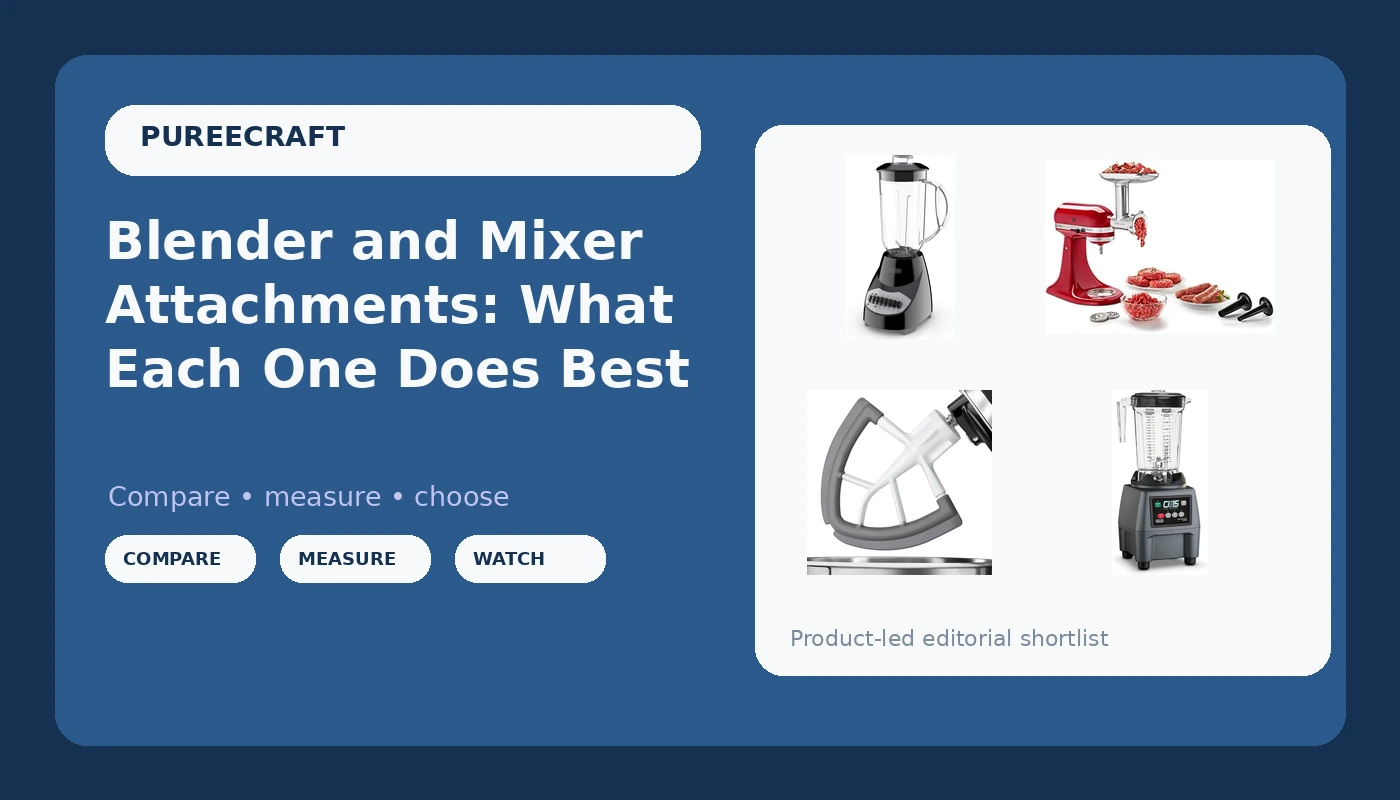
That is the idea behind this group of blender and mixer attachments. Two of the four products here are countertop blenders built around a jar and a blade. The other two mount on a KitchenAid stand mixer and borrow its motor for grinding and creaming. They are not competitors. They cover different jobs, and the only useful question is which job you actually have.
Related: How to Choose a Blender That Actually Crushes Ice →
Quick answer
Reach for a countertop blender when the job is crushing ice, blending frozen fruit, or pureeing soup in the jar. Reach for a stand mixer attachment when the mixer is already on your counter and the work is grinding meat, grating cheese, or creaming butter against the side of the bowl. Capacity, not wattage, is the first thing to match to your kitchen: a one-gallon jar is a batch machine, and a standard countertop jar is a household machine.
Four useful options
| Model | Best fit | What stands out |
|---|---|---|
| BLACK+DECKER Crush Master Blender, 10-Speeds with Stainless Steel Blades, Black, BL2010BP | Everyday smoothies, sauces, and small batches | Ten speed settings and a stainless steel blade assembly |
| KitchenAid KSMMGA Food Grinder Attachment for All KitchenAid Stand Mixers | Grinding meat, cheese, and dry goods on a stand mixer | Fits all KitchenAid stand mixers and uses the mixer's own motor |
| Flex Edge Beater for KitchenAid,Mixer Attachement Compatible With KitchenAid,Mixer Accessory,Fits Tilt-Head Stand Mixer Bowls For 4.5-5 Quart Bowls,Beater With Silicone Edges,Grey | Creaming, mixing, and scraping down the bowl | Silicone edges on a beater sized for 4.5 to 5 quart tilt-head bowls |
| Waring One-Gallon Food Blender with Electronic Keypad & Copolyester Jar | High-volume batch blending | One-gallon copolyester jar with electronic keypad controls |
Everyday countertop blender: BLACK+DECKER Crush Master Blender, 10-Speeds with Stainless Steel Blades, Black, BL2010BP
The case for a machine in this class is straightforward. It covers the everyday work, it does not demand much counter space, and it does not ask you to commit to a commercial budget before you know whether you will still be making smoothies in March.
The case against it is headroom. Ten speeds give you control, but control is not the same thing as torque, and the blends that punish a lighter-duty machine are the thick, low-liquid ones: nut butter, a kale and frozen mango smoothie, a dip that needs to stay chunky rather than turn to soup. If your routine is mostly frozen fruit and ice, the question that matters is not how many speeds the dial offers but whether the jar shape funnels that frozen load down into the blade path. A jar that leaves food stuck on the walls turns a thirty-second job into a five-minute fight with a spatula.
Buy this one when the goal is a reliable household blender for normal quantities. Skip past it when you already know you blend for a crowd, or when ice is the main event several times a day.
Grinder attachment: KitchenAid KSMMGA Food Grinder Attachment for All KitchenAid Stand Mixers
This is the piece of the lineup that has nothing to do with smoothies, and that is the point. A stand mixer is a geared, low-speed, high-torque machine, which is exactly the profile grinding wants. Blenders spin fast and rely on blade speed; grinders push food through a plate and rely on force. Asking a blender to do that job is how you end up with uneven texture and a strained motor.
The practical appeal is consolidation. If a KitchenAid stand mixer is already on your counter, this attachment turns it into a grinder without buying, storing, and cleaning a separate appliance. The trade-off is that the mixer has to be out and set up, and grinding is a slower, more deliberate process than blending. You also inherit the mixer's limits, because the attachment can only be as capable as the motor turning it.
Choose it when you already own a compatible stand mixer and you want control over what goes into your ground meat, or when you grate hard cheese and stale bread often enough that doing it by hand has become annoying.
Beater attachment: Flex Edge Beater for KitchenAid,Mixer Attachement Compatible With KitchenAid,Mixer Accessory,Fits Tilt-Head Stand Mixer Bowls For 4.5-5 Quart Bowls,Beater With Silicone Edges,Grey
A standard flat beater leaves a ring of butter, sugar, or batter stuck to the bowl, and every recipe that says "scrape down the bowl" is asking you to stop the mixer and deal with it. A beater with flexible edges handles part of that job on its own, because the silicone sweeps the bowl wall as the beater rotates.
Two details deserve attention before you buy. The first is fit: this beater is sized for tilt-head mixers with 4.5 to 5 quart bowls, and it will not suit a bowl-lift model or a larger bowl. The second is branding. This is a compatible accessory, not a KitchenAid part, so if matching the rest of your mixer matters to you, that is a real consideration.
Choose it when you already own a compatible tilt-head mixer and you are tired of scraping. Skip it if you bake rarely enough that the stock beater has never bothered you.
Batch blender: Waring One-Gallon Food Blender with Electronic Keypad & Copolyester Jar
A one-gallon jar changes the arithmetic of blending. Instead of making two smoothies one at a time, you make a full batch and pour it out. That matters for meal prep, for juice and smoothie programs, for sauces and soups made in quantity, and for anyone feeding a household that drinks in rounds rather than singles.
The trade-offs are real and worth naming. A jar that size is heavy when it is full, it takes up counter or storage space that a standard jar does not, and it is overkill for a single serving. Copolyester, the jar material here, is common in commercial jar designs because it handles impact better than glass and weighs less, though it is not immune to scratching over time. The keypad controls suit repeatable batch work better than a dial, since you can return to the same setting without hunting for it.
Choose this machine when volume is the point: a daily batch, a small food business, or a kitchen where the blender runs for other people as often as for you. If you blend one serving at a time, this is the wrong size of tool.
Prices and availability may change. Product images, names, and retailer links must be matched by verified ASIN. Do not state a current price, rating, stock status, or measured result without current evidence.
Why jar geometry beats the wattage number
Wattage is the easiest thing to print on a box and the least useful thing to shop by. A motor only matters if the food reaches the blades, and that is a design problem, not a power problem.
Blade geometry decides what happens when food arrives. Angled blades pull material down and inward; flat blades fling it outward. A jar that narrows toward the blade creates a funnel that keeps ingredients in the path. A jar with wide, straight walls and a blunt blade lets frozen fruit ride the sides until you stop the machine and push it down by hand.
That is why the tamper exists on high-end machines and why its absence on a thick-blend machine is a warning sign. A tamper is not a gadget. It is the tool that keeps a low-liquid blend moving when gravity alone will not do it.
Speed settings are a control feature, not a capability feature. Ten speeds let you pulse for a coarse chop and run steady for a puree. They do not change how much torque the motor produces or how well the jar circulates food. When you compare a compact countertop blender against a one-gallon batch machine, you are comparing two different jobs, not two points on the same scale.
What a stand mixer attachment can and cannot replace
Attachments are the most misunderstood category in the kitchen, because they look like accessories and behave like appliances. A food grinder mounted on a stand mixer is a genuine grinder. A beater with silicone edges is a genuine improvement over scraping by hand. What they cannot do is change the machine underneath them. The attachment inherits the mixer's motor, the mixer's speed range, and the mixer's need to be set up and cleaned.
So the honest framing is this: attachments extend a machine you already own into jobs it could not otherwise do. They are excellent value if the mixer is already there. They are a poor substitute for buying the right primary appliance.
- Start with the texture you need, not the appliance you like. Smooth and pourable points to a blender. Ground, grated, or creamed points to a mixer attachment.
- Count the servings. One or two servings fit a standard countertop jar. A full batch for the week points toward a one-gallon machine.
- Check what is already on your counter. If a compatible stand mixer is out, the attachments add capability at a fraction of the footprint.
- Verify the fit before you buy. The beater is sized for tilt-head mixers with 4.5 to 5 quart bowls, and the grinder is built for KitchenAid stand mixers.
- Decide how it gets cleaned. A tool you dread washing is a tool you stop using, and that calculation matters more than any spec on the box.
Practical guidance for whichever tool you choose
- Rinse the jar or bowl within a few minutes of use, before residue dries onto the blades or the beater.
- Inspect the jar base seal and the silicone edges on the beater periodically. Worn parts are the usual cause of leaks and streaks.
- Respect the fill line on a one-gallon jar. Overfilling does not speed up a batch, it just pushes liquid past the lid.
- Pulse for chopping and run steady for purees. Short bursts preserve texture, while long continuous runs build heat.
- If a thick blend stalls, stop and scrape down instead of pouring in liquid. Liquid changes the recipe; a spatula does not.
Which option should you choose?
Choose the BLACK+DECKER Crush Master Blender, 10-Speeds with Stainless Steel Blades, Black, BL2010BP when you want one compact countertop machine for everyday smoothies, sauces, and small batches. Choose the KitchenAid KSMMGA Food Grinder Attachment for All KitchenAid Stand Mixers when a KitchenAid stand mixer is already on your counter and you want to grind meat, cheese, and dry goods without adding another appliance. Choose the Flex Edge Beater for KitchenAid,Mixer Attachement Compatible With KitchenAid,Mixer Accessory,Fits Tilt-Head Stand Mixer Bowls For 4.5-5 Quart Bowls,Beater With Silicone Edges,Grey when you own a compatible tilt-head mixer and want the bowl scraped while you mix. Choose the Waring One-Gallon Food Blender with Electronic Keypad & Copolyester Jar when batch volume is the whole point and a single serving was never the goal.
The overlap is worth acknowledging. A countertop blender and a stand mixer attachment can both puree cooked vegetables, and the choice between them comes down to quantity and cleanup rather than capability. Match the tool to the job you repeat most often, not the job you imagine doing once.
The bottom line
These four products are not four versions of the same decision. They are two decisions. The blenders answer the question of how much you blend at a time, from a household jar up to a one-gallon batch machine. The stand mixer attachments answer a different question: whether the machine already sitting on your counter can be extended into grinding and creaming instead of replaced. Figure out which question you are actually asking, and the choice narrows quickly.