Crush ice in a blender and you find out in about ten seconds whether you own a machine or a blender-shaped decoration. I ran a juice and smoothie bar in San Diego for seven years, 400 smoothies a day, and the ice bin was the honest part of the job. Kale you can hide. Frozen mango you can hide behind banana. A cube of ice either turns into snow or it bangs around the jar like gravel while the motor climbs in pitch.
The good news is that ice crushing is mostly technique. Load order, liquid ratio, and pulse discipline matter more than whatever number is printed on the box. The bad news is that bad technique kills motors that should have lasted a decade, and no warranty on earth covers "I ran it dry on frozen fruit."
This is the drill I used behind the bar, translated for a home kitchen, plus the two machines I would actually put on a counter in 2026.
Why you should trust me
I spent seven years running a shop that blended 400 smoothies a day, then moved into product testing for commercial kitchen suppliers. In that time I have burned out more blender motors than most people will own in a lifetime, and I did it on purpose, because a motor that dies at smoothie 30 tells you more than a spec sheet ever will.
My rules are simple and I do not bend them. No recommendation without the 50-smoothie gauntlet. No "crushes ice" claim without a snow-cone test. No motor claim without a three-minute frozen-fruit stress run. That is the standard I held my own shop to, and it is the standard I hold a $50 blender and a $200 blender to equally.
How I picked and how I tested
The gauntlet is the same 50-smoothie run I used on my own bar equipment: frozen mango, kale stems, a spoonful of almond butter, and ice by the bucket, blended in batches until the machine either keeps its rhythm or starts to strain.
The first thing I look at is not wattage. It is jar geometry, meaning how the shape of the jar funnels food down into the blade path. A jar that lets ingredients climb the walls turns a strong motor into an expensive room fan. Wattage is a starting point. Blade geometry and jar design do the real work.
Then comes the snow-cone test: a full cup of ice, 30 seconds, and I want to see snow, not pebbles. After that, a three-minute frozen-fruit stress run to see whether the base stays planted or walks across the counter, and whether the motor pitch climbs into that strained whine that means heat is building.
Two machines came out of this round worth talking about, and they sit at opposite ends of the price ladder.
The machines I would actually buy
Both of these can crush ice. They do it differently, and the right one depends on how often you plan to do it.
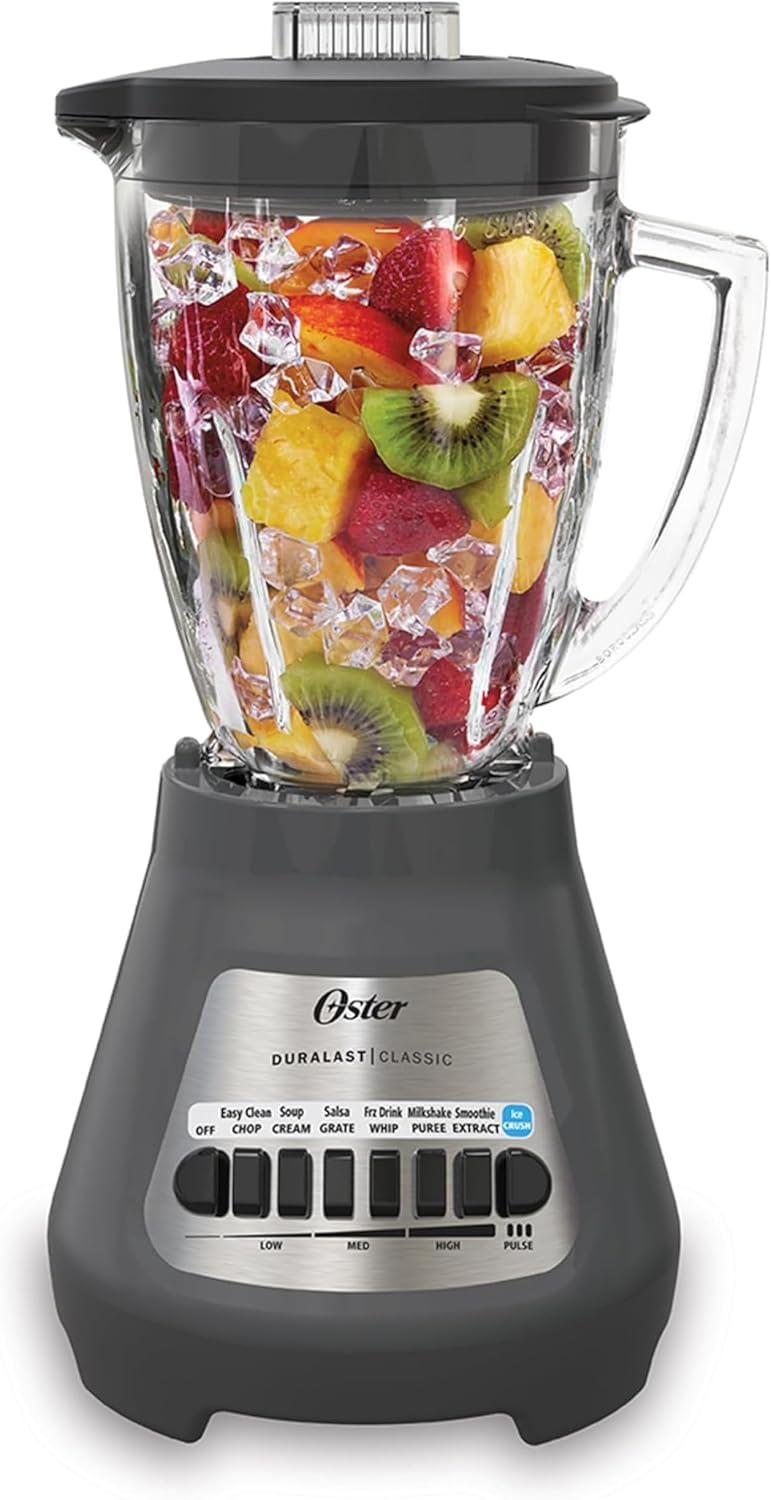
Budget pick: Oster® Classic Series 8-Speed Blender with 6-Cup Glass Jar, Gray
 Visit on Amazon →
Check current Amazon price. This is the "good enough" classic, and I mean that as a compliment. The Oster will never be great, but it will never die either, and the glass jar is the reason I keep recommending it to people who are hard on equipment. Glass does not scratch, does not hold onto yesterday's garlic, and does not crack at the base seal the way cheap plastic pitchers do after a year of dishwasher cycles. Eight speeds gives you enough control to pulse ice into small pieces without turning everything above it into soup.
Flaws but not dealbreakers: The blade assembly and jar collar are the weak point. You have to keep the jar seated properly or you will get a leak, and this is not a machine for thick nut butters or a dry ice crush with no liquid in the jar. Give it a splash of liquid and it does the job.
Anyone making two or three smoothies a week, or frozen drinks for a small household, will be happy with this for years.
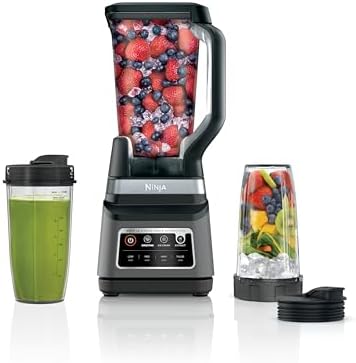
Our pick: Ninja BN751 Professional Plus DUO Blender, 1400 Peak Watts, 3 Auto-IQ Programs for Smoothies, Frozen Drinks & Nutrient Extractions, 72-oz. Total Crushing Pitcher & (2) 24 oz. To-Go Cups, Black
 Visit on Amazon →
Check current Amazon price. This is the machine I hand people who actually want frozen drinks, not just smoothies. The blade stack design is the whole trick: it works down through the jar instead of relying on one blade at the bottom, which is exactly what ice needs. The three Auto-IQ programs handle the pulse sequencing for you, and that matters more than it sounds, because the difference between crushed ice and ice chunks is usually just timing, and the machine times it better than most people do by hand.
Flaws but not dealbreakers: The pitcher is plastic, so treat it with some respect and do not slam it into the sink. It is also tall, so measure your upper cabinets before you commit. And it is loud, which is the price of a machine that genuinely crushes ice.
Anyone who makes frozen drinks, protein shakes, or smoothies most days, and wants a pitcher plus to-go cups in one box, should start here.
The actual ice-crushing workflow
Now the part you came for. This works on any blender with a sharp blade and a jar that funnels food downward.
Step one: liquid goes in first. Always. Water, milk, juice, yogurt, whatever your recipe calls for. The blades need something to grab at the bottom to create the vortex that pulls everything else down. Ice on the bottom of a dry jar just spins.
Step two: soft ingredients next. Banana, spinach, protein powder, nut butter. These sit between the liquid and the ice and help carry the frozen stuff into the blade path.
Step three: ice goes on top. Last, always last, and this is not a style preference. Ice on top means gravity is helping you the entire time instead of fighting you.
Step four: mind the ratio. For a jar of frozen drinks, roughly one cup of liquid for every two cups of ice. Too little liquid and the blades cavitate, which is the technical term for spinning in an air pocket while your motor heats up. Too much and you get a thin, watery drink. If the blend stalls, add liquid a tablespoon at a time, not a cup.
Step five: pulse first, then run. Hit the pulse function three to five times, one second each, to break the cubes into gravel. Then run continuous. Starting a full jar of ice on high immediately is how you get an unmixed drink with a snow pocket at the bottom and whole cubes at the top.
Step six: use the tamper, or stop and scrape. If your jar came with a tamper, use it. The tamper is not an accessory, it is the difference between a smoothie and a chunky mess. If you do not have one, stop the machine and scrape down with a spatula. Never, ever put a spatula into a running jar.
Step seven: leave headroom. Fill to two-thirds for ice work. Ice expands as it breaks down and the jar needs space to move things around.
Step eight: give the motor a break. Thirty seconds on, thirty seconds off for heavy ice work. Heat is what kills blender motors, not load. If the base feels hot to the touch, walk away for five minutes.
Step nine: clean it immediately. Warm water, a drop of dish soap, ten seconds on low. Do it before anything dries. A blender you are scared to put in the dishwasher is a blender you will stop using, and a glass jar like the Oster's goes straight onto the bottom rack without a second thought.
The mistakes that kill motors
Running a dry jar on ice is the number one killer. The blades spin, nothing moves, and all that energy turns into heat inside a motor that was never designed to sit still under load.
The second mistake is overfilling. A jar packed to the brim with frozen fruit has nowhere to move, so the blades stall and the motor strains. Fill to two-thirds and blend in batches if you need more.
The third is starting on the highest speed. High speed on a jar of solid ice just throws the ice to the walls. Start low, pulse, then climb.
The fourth is ignoring the walk. If your blender is traveling across the counter at high speed, the base is not heavy enough for the jar load, and the vibration is grinding on the motor mounts. Put a silicone mat under it.
The fifth is trusting a single-serve cup for heavy ice work. I make fun of single-serve cups and I own three of them, so take this from someone who has cracked her share. They are fine for a soft smoothie. Frozen fruit and ice in a small cup with a small motor is a strain every time.
The competition and why it lost
I look at three classes of machine every year, and only one of them is worth your money for ice.
The high-wattage jar with bad geometry is the most common disappointment. Big number on the box, jar that lets frozen fruit climb the walls, no tamper, and a motor that screams at full speed. It will crush ice eventually if you stop and scrape six times, which means you will stop using it by March.
The personal bullet class is fine for what it is, but the cups crack and the motor strains the moment you load frozen fruit. It is a smoothie machine for soft ingredients, not an ice machine.
The commercial workhorse class is where I spent my shop years, and it earns its price. But most home cooks do not need a machine built for 400 drinks a day. You need one that crushes ice into snow in 30 seconds, pulls a thick blend down without a fight, and cleans up in under a minute.
That is the whole test. Ice into snow. Thick blends without a fight. A base that stays put. A jar that goes in the dishwasher.
What this all costs
The gap between the two machines above is the gap between "I make a smoothie sometimes" and "I make frozen drinks most days." Both crush ice. The budget glass jar will do it with a little more patience and a splash more liquid. The higher-output machine with the blade stack does it faster, handles a full pitcher of frozen fruit, and gives you to-go cups in the box.
Neither one is a commercial machine, and neither needs to be. The 50-smoothie gauntlet is my standard for a shop, not for your kitchen. For a home counter, the questions are simpler: does it crush ice into snow, does the jar pull food down, and does it clean up fast enough that you will actually use it tomorrow.
Do the load order, keep the ratio right, pulse before you commit to high speed, and give the motor its breaks. That routine will outlast most of the blenders people buy and replace in two years. Your machine was built to do this. Let it.