Most blenders do not die from a lack of watts. They die because the jar cannot pull food down into the blade path, and the person standing over it gives up before the frozen mango ever breaks down. I ran a juice and smoothie bar in San Diego for seven years at 400 smoothies a day, and I burned out more motors than most people will own in a lifetime. Frozen mango, kale stems, almond butter, ice by the bucket. Learning how to use a countertop blender properly was the difference between a machine that lasted a decade and a machine that lasted a summer.
Now I test blenders for commercial kitchen suppliers, and the same rule holds. The machine is half the equation. The other half is technique, and technique is free.
This is the workflow I run on every machine I touch, plus the two blenders I would actually put on a home counter this year.
Why you should trust me
Seven years behind a smoothie bar, 400 drinks a day, one Vitamix 5200 that ran the whole stretch on a single motor. Then I moved to the supply side, testing blenders the way my old shop did: frozen fruit, greens, nut butter, and a stopwatch, run until something either gives up or does not.
I keep a short list of boundaries I do not cross. No recommendation without a long gauntlet of thick blends. No "crushes ice" claim without an actual snow test. No motor opinion without a frozen fruit stress run. And no patience at all for a base that walks across the counter on high, because I have chased one across a prep station and it is not charming.
How I judged these two machines
The short version of what separates a good blender from a bad one has almost nothing to do with the number printed on the box.
Jar geometry is the real differentiator. A jar that funnels food into the blade path will out-blend a more powerful motor in a lazy jar every time. Blade geometry matters too, and so does the material the jar is made from, because a jar that cracks at the base seal ends the machine's life no matter how healthy the motor is.
Then there is the tamper question. On a thick blend, the tamper is not an accessory. It is the difference between a smoothie and a chunky mess, and a thick-blend machine that does not ship with one is telling you something about itself.
The last thing is noise and stability. If the base screams and creeps at high speed, you will use the machine less. That is not a small thing. A blender you avoid is a blender you wasted money on.
The two machines I would put on a home counter
Both of these are built around the same idea: a jar that pulls food down, and a motor that can run long enough to finish the job without a babysitter.
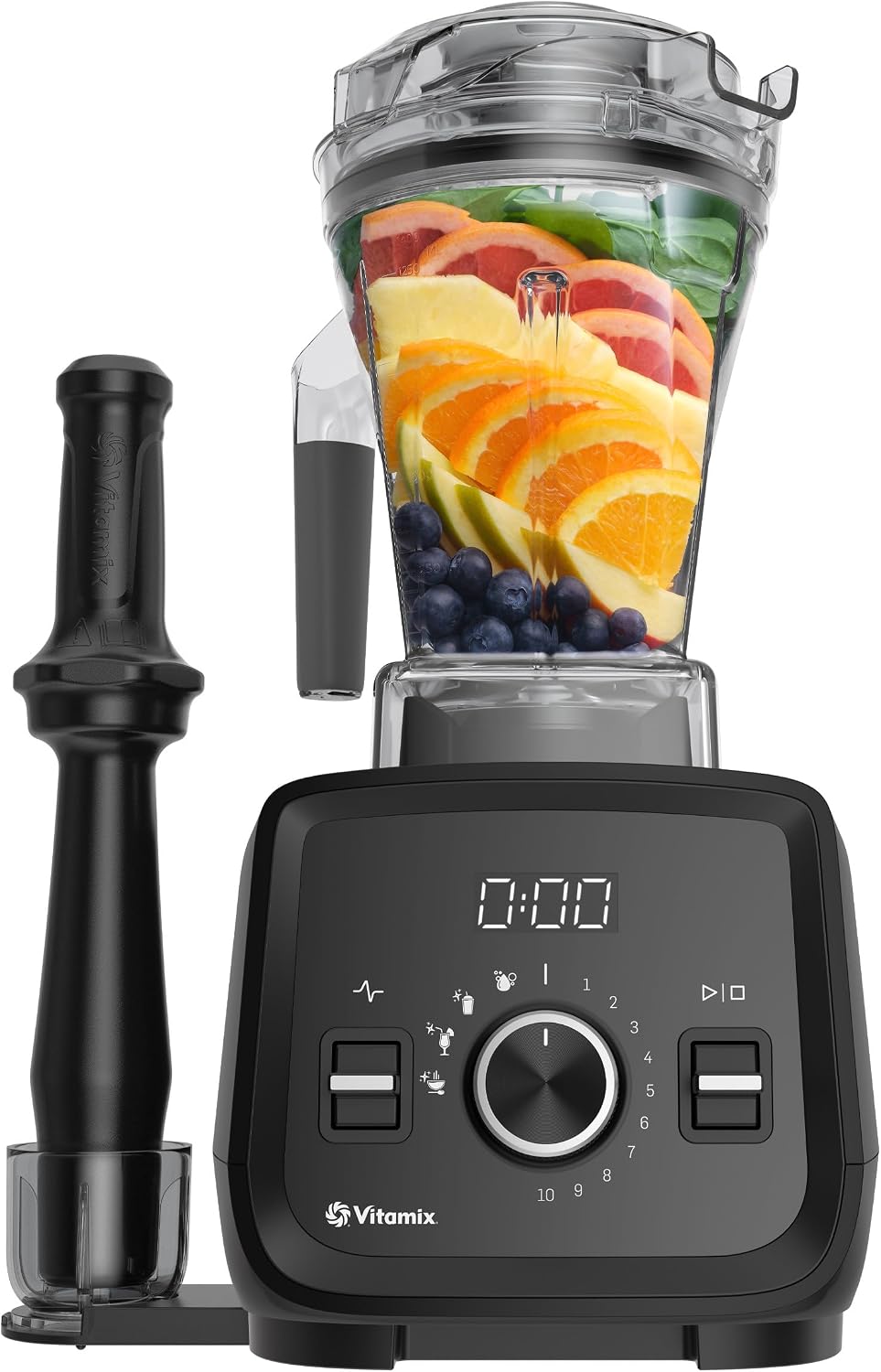
The upgrade pick: Vitamix VX3 Professional-Grade Blender, 3 Programs, Black
 Visit on Amazon →
If you want the machine that ends the argument, this is it. Vitamix is the brand my old shop ran on, and the VX3 carries that commercial-grade build logic into a home unit with three preset programs, which is the part I care about more than I expected to. Presets sound like a gimmick until it is 6 a.m. and you are making the same smoothie you make every morning.
The three programs cover the jobs that actually come up: smoothies, frozen desserts, and hot soup. That last one matters more than people realize. A machine rated to run long enough to heat soup by friction is a machine rated to run long enough to break down kale stems and frozen mango without you standing over it.
What I like here is the jar. It pulls thick blends down into the blade path instead of letting them climb the walls, and that is the single biggest reason cheap blenders fail at nut butter and thick smoothies. The tamper is included, and on a machine in this class it should be.
Check current Amazon price, and understand what you are buying: this is the buy-once machine. If you blend five days a week and you want to stop thinking about your blender, this is where you stop looking.
Flaws but not dealbreakers: It is loud. Vitamix loud, the kind of loud that makes you warn the household before you hit start. And it costs real money, which is the actual objection, not the performance.
Anyone who has already killed a budget blender on frozen fruit will get the most out of this one.
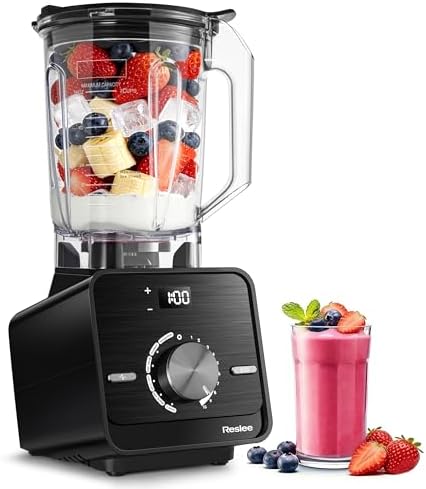
The value pick: Professional High Power Blender, 2026 Upgraded 3.5HP Motor 30000 RPM, Heavy Duty Countertop Blender for Milkshake, Smoothie, Frozen Fruit & Ice, Hot Soup & Nut Milk, 72oz Eastman Tritan Jar, 10 Speeds
 Visit on Amazon →
This is the machine I point people to when the premium budget is not happening but the frozen fruit is not going away either. The spec sheet lists a 3.5HP motor and a 30,000 RPM top speed, and the jar is a 72-ounce Eastman Tritan, which is the material I actually want to see on a home blender because it handles dishwasher cycles without the stress cracking that clear polycarbonate develops over time.
Ten speeds plus pulse is the configuration I recommend for anyone learning technique, because pulse is the feature smoothie bars use constantly and almost nobody at home uses enough of. Pulse is how you chop without pureeing. If you want texture in a smoothie, or you want to break up frozen fruit before committing to a full blend, you will live on that button.
The jar size is the other thing worth noting. Seventy-two ounces is a family batch, and it is also big enough that a thick blend has room to move instead of packing into a brick at the bottom. It is rated for hot soup and nut milk, which tells you the motor is built for longer runs, not just quick ones.
Check current Amazon price. At the value end, the three things I check are jar material, the tamper situation, and whether the base stays planted. This one covers the first and the third.
Flaws but not dealbreakers: A machine with this much power in this price class will never be as quiet as the premium tier, and there are no presets, which means you choose your own speed every single time. For someone who wants to learn the craft, that is a feature rather than a flaw.
Anyone feeding a family of four, or blending daily on a mid-range budget, should start here.
The actual workflow
Now the part you came for. This works on either machine above, and on most decent blenders you already own.
Step one: Load in the right order. Liquid first, then soft ingredients, then leafy greens, then frozen fruit and ice on top. This is not superstition. The blades need something to pull against, and if you put frozen fruit at the bottom, the blade spins in a pocket of air while the fruit sits there. Liquid on the bottom gives the blade something to grab and creates the vortex that drags everything else down.
Step two: Do not overfill. A 72-ounce jar does not mean a 72-ounce smoothie. Leave headroom, roughly a quarter of the jar, so the vortex can actually form. An overfilled jar is the number one cause of "my blender is weak" complaints, and the fix costs nothing.
Step three: Start slow, then commit. Begin on the lowest speed and let the blades pull the load into a vortex before you move up. Starting on high throws ingredients up the walls and stalls the blend, which is how people end up scraping with a spatula while the motor whines.
Step four: Use pulse for texture. If you want chunks of fruit or a salsa texture instead of a puree, pulse. Short bursts chop. Continuous high speed purees. Knowing which one you want is most of the skill in this whole process.
Step five: Learn the tamper. On thick blends, nut butter, frozen dessert, anything with very little liquid, you will need to push the food down. Turn the machine off first, use the tamper, and never put anything but the tamper into the jar while it is running. A spatula through the lid is how people break machines and hands.
Step six: Give frozen fruit time. Frozen fruit does not break down in two seconds, and stopping every few seconds to scrape means your load order was wrong. Let the machine run and do the work before you judge it.
Step seven: Ice means snow, not slush. If you want a smoothie with real body, crush ice on its own first, or put it on top of the liquid and pulse. If your machine turns ice into water instead of snow, it is not an ice machine and no amount of technique will fix that.
Step eight: Clean it immediately. Fill a third of the jar with warm water and a drop of soap, run it on high briefly, then rinse. Do this before anything dries. A blender you are scared to wash is a blender you will stop using, and that is the real failure mode, not motor wear.
Ice is the honest test
Before you trust any blender, including the one on your counter right now, run this. Put a tray of ice into the jar with a small splash of liquid. Run it. If you get snow, the jar geometry and the blade are working together and the machine can handle real smoothie work. If you get whole cubes bobbing in cold water, the motor is spinning and the jar is not pulling, and no technique will rescue it.
That is why I do not buy blenders on wattage. Watts are a starting point, not a verdict. Blade geometry and jar design do the real work, and ice is where that shows up fastest.
The mistakes that kill motors
Three of them, in order of how often I see them.
The first is running thick blends on high for minutes at a time with no tamper and no added liquid. That is a motor working at a stall, and heat builds quickly.
The second is the wrong load order. Frozen fruit at the bottom means the blade never gets a clean bite, and the motor runs hot while the fruit just sits there.
The third is the dishwasher lie. If your jar is not dishwasher safe, hand wash it, and if the base seal is cracked, stop using the machine. A jar that cracks at the base seal is the most common way a good blender dies early, and it is almost always a washing habit problem, not a blending one.
What this all costs
The value machine is a mid-range countertop buy. The Vitamix VX3 is a premium one. Check current Amazon price on both before you decide, because the gap is real and it should buy you something specific: a stronger motor and jar geometry that handles thick blends without a fight.
The math that matters more than the sticker is per smoothie, not per machine. If you blend once a day, five days a week, for five years, that is roughly 1,300 smoothies. A cheap machine you replace twice costs more per smoothie than a premium machine you keep for a decade. That is the whole argument for buying up, and it only holds if you actually blend.
The bottom line
Technique first. Load order, headroom, pulse, tamper, and clean it while it is still wet. Do those five things and a mid-range blender will outperform a premium one that gets abused.
If you want the machine that removes the question entirely, the Vitamix VX3 is the one, and its preset programs make the daily routine nearly automatic. If you want the machine that handles frozen fruit and family batches without the premium price, the high power countertop blender with the Tritan jar is the smarter first buy.
Either way, stop judging blenders by the wattage on the box. Judge them by what comes out of the jar, and how fast you can rinse it out afterward.