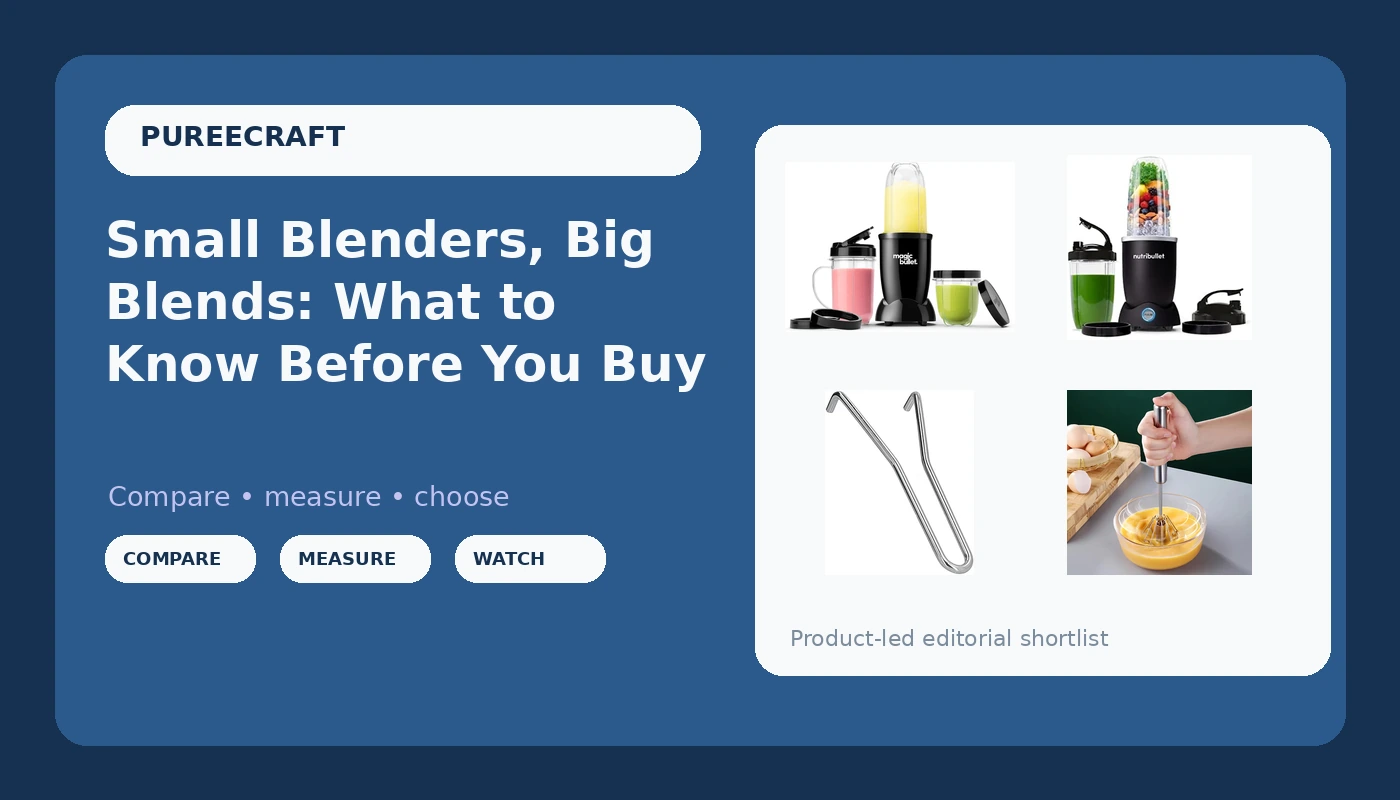
A personal blender setup is rarely one purchase. It is a motor base, one or more cups, a blade assembly, and the small tools that decide whether you can actually get at those blades when they need cleaning or replacing. Most shoppers buy the base and stop there, then wonder why a frozen mango smoothie stalls halfway down the jar or why a cup starts weeping at the seal a few months in. The four items below cover the whole loop rather than one slice of it: a higher-wattage personal blender, a compact multi-piece set, a hand-push rotary whisk for light mixing, and a stainless steel wrench built to separate a blade assembly from its jar. Once you see a personal blender setup as four separate jobs, the buying decision gets much smaller.
Related: How to Tell When a Blender Jar Seal Is Finished →
Quick answer
For most kitchens, the workable answer is a personal blender with enough motor to move frozen fruit, paired with at least one cup you will genuinely wash every day. The nutribullet Pro+ Personal Blender 1200W combines a 1200-watt motor with a pulse function and auto shut-off, and it includes both a 32 oz and a 24 oz to-go cup, so one machine covers a full batch or a smaller serving. The magic bullet Blender, Small, Black, 11 Piece Set does a similar job in a smaller footprint with more pieces in the box. A hand-push rotary whisk handles eggs and light emulsions with no power at all. A stainless steel blade wrench is the maintenance piece: it lets you separate the blade from the jar for deep cleaning or replacement instead of retiring the whole cup.
4 useful options
| Model | Best fit | What stands out |
|---|---|---|
| nutribullet Pro+ Personal Blender 1200W, Pulse Function, Auto Shut-Off, Nutrient Extractor for Smoothies, Shakes & Salsas, Includes 32 oz & 24 oz To-Go Cups, Matte Black | Daily smoothies, shakes, and salsas | 1200-watt motor, pulse function, auto shut-off, 32 oz and 24 oz to-go cups included |
| magic bullet Blender, Small, Black, 11 Piece Set | Small kitchens and single servings | Compact 11-piece set in black, with multiple vessels in one box |
| Blender Open Wrench Tool, Stainless Steel Mixing Cup Blade Wrench, Blender Blade Fixed Replacement, Disassemble The Blade from Jar Mixer Accessories | Blade and jar maintenance | Stainless steel wrench made to separate the blade assembly from the jar |
| Stainless Steel Semi-Automatic Whisk,Egg Whisk Hand Push Rotary Blender | Eggs and light mixing | Hand-push rotary action, stainless steel, no electricity required |
The daily driver: nutribullet Pro+ Personal Blender 1200W
The trade-off here is straightforward: more motor and two cup sizes means more countertop presence and more parts to store. If you blend one smoothie a day and never anything frozen, this is more machine than the job requires. If frozen mango, kale stems, and ice are routine, the extra wattage and the pulse control are the features that keep the blend moving instead of stalling. The 24 oz cup is the one most people reach for on a weekday; the 32 oz cup is what makes a two-person breakfast possible without running the machine twice.
The compact set: magic bullet Blender, Small, Black, 11 Piece Set
The honest trade-off with any compact set is batch size. A small jar is easy to store and easy to rinse, and it is also easy to overfill, which is where most stalling complaints start. Fill lines exist for a reason: pack frozen fruit above the line and the blades have nothing to pull down. If you regularly blend for two people, expect to run this twice. If you blend one serving and want the machine off the counter by the time the coffee finishes, the smaller footprint is the whole point.
The maintenance piece: Blender Open Wrench Tool
This is the least glamorous item in the group and the one that extends the life of everything else. The gasket under a blade assembly is where old smoothie goes to live, and once residue builds up there, leaks and smells follow. Hand-tightening a blade assembly back onto a jar is fine; forcing a stuck one by hand is how seals get twisted. Match the wrench to your cup's blade base before you apply real pressure, and never use it on a jar that is still seated on a running base.
The no-power helper: Stainless Steel Semi-Automatic Whisk
The reason to keep one of these next to a blender is volume. A blender jar needs enough liquid and enough food to actually circulate, which is why a two-egg scramble in a 32 oz cup is a mess and a hand whisk is not. Use the whisk for the small jobs, keep the blender for the jobs that fill a cup, and you will run the motor less and wash fewer large parts.
Prices and availability may change. Product images, names, and retailer links are matched to verified listings. No current price, rating, stock status, or measured result is stated here without current evidence.
What the wattage number does and does not tell you
Wattage describes how much power a motor can draw, not how well a jar moves food into the blade path. That distinction explains a lot of confusing shopping. A 1200-watt motor in a jar with poor geometry will still leave frozen fruit spinning in a pocket above the blades, while a lower-wattage machine with a narrow, tapered jar can pull the same load down and through. Motor ratings are a starting point for comparison and a poor substitute for looking at the jar.
The features that matter more than the number are the ones that change how you use the machine. Pulse lets you run short bursts, which is how you chop without turning everything into puree; it is the control that gets used constantly in any setting where texture matters. Auto shut-off protects the motor from a blend that has gone nowhere and prevents an unattended run. Cup volume determines how many times you repeat the whole process, and blade access determines whether you can clean the assembly properly or only rinse around it.
So the useful question is not "how many watts" but "what happens when I put frozen fruit and ice in it." A machine that has to be coaxed, tamped, and shaken for two minutes is not doing the job, regardless of what the box claims. A machine that pulls the load down, blends, and stops when you tell it to is.
Where small blenders actually fail: blades, seals, and cups
Failures in personal blenders cluster in three places, and none of them is the motor.
The first is the seal between the blade assembly and the jar. That gasket takes the pressure of every blend, and it is the part that leaks first. Threading the blade assembly on crooked, overtightening it, or running it through a hot cycle it was not designed for all shorten its life. When a cup starts weeping at the base, the fix is usually the gasket or the assembly, not the whole blender.
The second is blade access. If the blade cannot be removed from the jar, residue collects underneath it where no brush reaches, and the only remaining options are a long soak or a replacement cup. A wrench that separates the two turns a throwaway into a maintenance job.
The third is cup volume and material. Cups that are too small for the way you actually blend get overfilled, and overfilled cups stress both the seal and the motor. Cups that crack at the base are usually cups that have been dropped, overtightened, or run hot.
- Check the jar's fill line against what you actually blend in a normal week.
- Confirm the blade assembly can be removed from the jar, not just rinsed in place.
- Match the pulse control to how often you want texture instead of puree.
- Verify cup volume covers one serving or two, whichever is your real habit.
- Decide whether the machine will sit on the counter or live in a cabinet, then size it accordingly.
How to keep a personal blender in daily rotation
- Blend in the order that protects the blades: liquid first, then soft ingredients, then frozen fruit and ice on top.
- Respect the fill line. A personal blender cup that is packed to the rim has nowhere for the contents to move.
- Use pulse for anything you want chopped rather than liquefied, and steady speed for smooth results.
- Rinse the cup and blade assembly immediately after use, before residue dries under the gasket.
- Separate the blade from the jar periodically for a real clean, and check the gasket for stiffness or cracks while it is apart.
Which option should you choose?
Choose the nutribullet Pro+ Personal Blender 1200W when frozen fruit, ice, and thicker blends are routine and you want two cup sizes from one base. Choose the magic bullet Blender, Small, Black, 11 Piece Set when counter space is tight, you blend single servings, and you want the vessels included in one purchase. Choose the Blender Open Wrench Tool when you already own a personal blender and want to clean or replace the blade assembly instead of replacing the cup. Choose the Stainless Steel Semi-Automatic Whisk when your small jobs are eggs, thin batters, and dressings that do not need a motor at all.
None of these choices requires a commercial machine. What they require is an honest read of your own habits: how much you blend at once, how often you use frozen ingredients, and how much cleaning you will tolerate before the blender ends up in a cabinet.
The bottom line
A personal blender setup works when the motor, the cups, and the maintenance pieces are chosen together. A 1200-watt personal blender with pulse, auto shut-off, and two cup sizes covers the majority of daily blending, and the compact 11-piece set covers the same ground for smaller kitchens and smaller batches. The wrench and the hand-push whisk are not accessories in the decorative sense; they are what keeps the blade assembly serviceable and what keeps small mixing jobs out of a jar that was never sized for them. Buy the motor you need, keep a cup you will wash, and make sure you can get the blade off the jar. Everything else is preference.