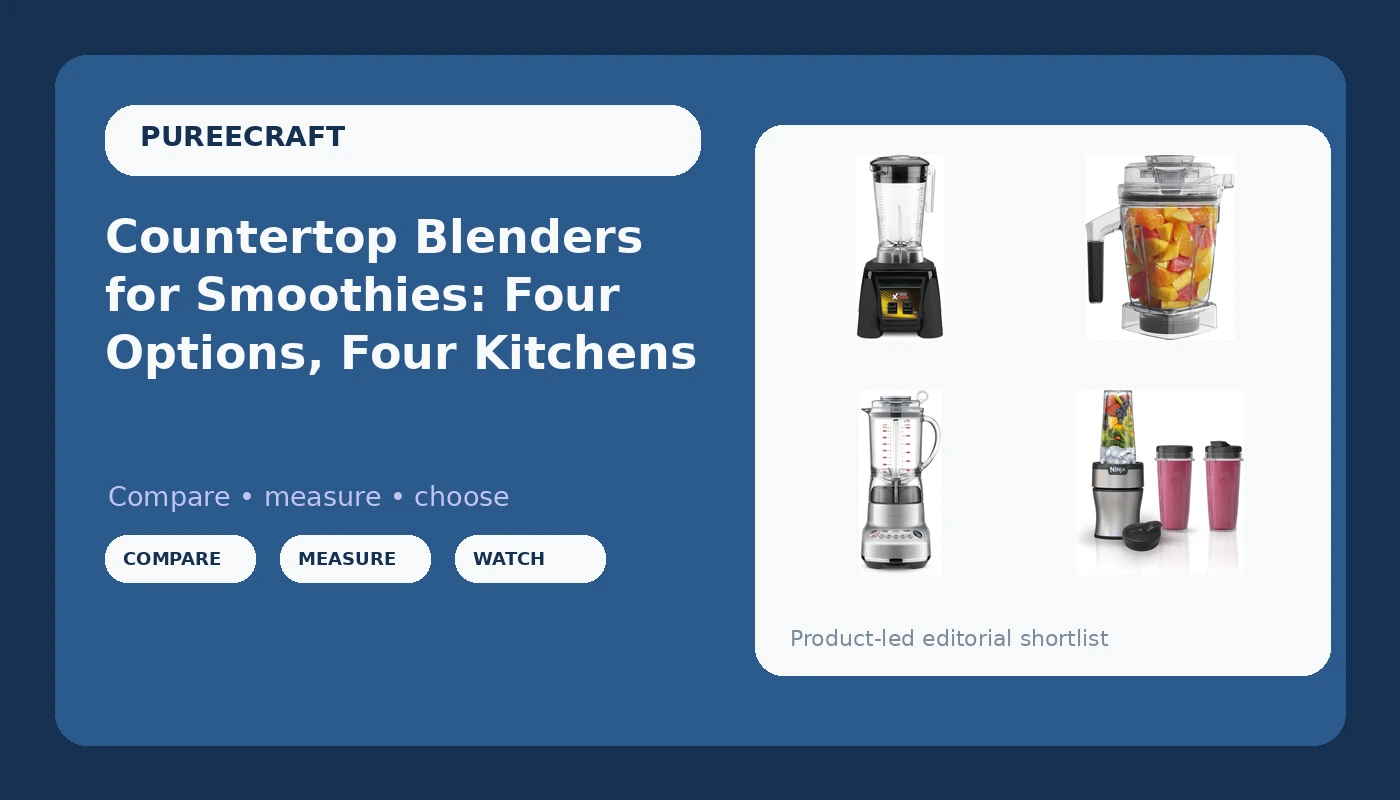
Shopping for countertop blenders for smoothies is where a lot of kitchen money goes sideways, because the box sells wattage and the smoothie is won or lost on jar geometry. A machine can carry an enormous number on the front panel and still leave kale spinning against the wall while frozen mango sits in a lump on top of the blades. The four products here are not four flavors of the same thing. One is a commercial-grade machine built for back-to-back batches, one is a replacement container that upgrades a base you may already own, one is a mainstream full-size kitchen blender, and one is a personal-cup unit that comes with a cup for everyone in the house. Picking well means knowing which job you are actually hiring for.
Related: Blender Jar Materials Explained: Tritan, Copolyester, and Glass →
Quick answer
For most home kitchens, the deciding factors are whether the jar pulls thick blends down into the blade path and whether the parts survive a dishwasher cycle. If you already own a compatible SELF-DETECT Vitamix base, the 48 oz Vitamix container is the most direct way to change your batch size. If you blend one or two servings at a time, a personal-cup machine covers the job with the least counter space. If you blend for a household, a cafe, or a small food business, the commercial Waring is built for that workload and the others are not. Breville's Fresh and Furious sits in the middle as a full-size countertop blender for everyday kitchen work.
Four useful options
| Model | Best fit | What stands out |
|---|---|---|
| Waring Commercial MX1000XTX 3.5 HP Blender | High-volume blending and small food businesses | 3.5 HP motor, paddle switches with a pulse feature, 64 oz BPA-free copolyester container |
| Vitamix 48 oz. Blender Container with SELF-DETECT | Owners of a compatible Vitamix base who want a different container size | 48 oz BPA-free Tritan container that a compatible base detects automatically |
| Breville BBL620SIL Fresh and Furious Blender | Everyday full-size blending in a home kitchen | Silver countertop blender from Breville's Fresh and Furious line |
| Ninja Nutri-Plus Personal Blender BN301 | Single servings, small kitchens, multiple users | 900-peak-watt push-to-blend motor, three 20-oz cups, two spout lids, one storage lid, dishwasher safe |
The commercial workhorse: Waring Commercial MX1000XTX Blender
The trade-off with a commercial unit is everything around the motor. It wants counter space and cabinet clearance, it is loud by design because it is moving a lot of air and a lot of food, and that 5-15 phase plug means a standard household outlet in North America, but a machine this size still deserves its own circuit rather than sharing with a microwave. Paddle switches are a commercial habit: they are simple, they survive wet hands, and the pulse paddle lets you chop without pureeing. If your actual routine is one smoothie a day, this is more machine than the job requires, and you will feel that every time you move it to wipe the counter.
The upgrade path: Vitamix 48 oz. Blender Container with SELF-DETECT
This is the one entry on the list that only makes sense in context. If you own a SELF-DETECT Vitamix base, a second container in a different size is the least disruptive upgrade in blending: you keep the motor you already trust and change how much you can process in one go, or you keep one container for savory work and one for smoothies. If you do not own a compatible base, this purchase does nothing for you, and no amount of enthusiasm about the brand changes that. Container capacity is also not the same as usable capacity. A 48 oz jar has a fill line well below the rim, and thick blends need headroom for the vortex to form.
The everyday countertop blender: Breville BBL620SIL Fresh and Furious
This is the middle of the market and the middle of the counter, and that is a real position rather than a compromise. A full-size jar lets you build a smoothie for two or three people without splitting batches, and it lets you do the other jobs a personal cup cannot: soup bases, pancake batter, sauces, and purees for a whole tray of vegetables. The trade-off is footprint and cleanup. A full-size jar takes up cabinet or counter space, and the lid, blade assembly, and gasket all need attention after thick blends. If you make one serving and drink it on the way out the door, this is the wrong shape of appliance for you.
The personal-cup option: Ninja Nutri-Plus Personal Blender BN301
Three cups is the underrated part of this package. Personal blenders fail socially more often than they fail mechanically: one cup means one person blends, and everyone else makes toast. With three cups and spout lids, a household can prep and go, and the storage lid means a cup can sit in the fridge with the blade assembly removed. The honest limits of the category are frozen fruit volume and thick nut butters, which ask more of a small motor than a single serving of fruit and yogurt does. Push-to-blend operation is simple, but simple also means you control the texture by how long you hold it.
Prices and availability may change. Product images, names, and retailer links must be matched by verified listing. Do not state a current price, rating, stock status, or measured result without current evidence.
What wattage and horsepower do not tell you
A motor rating describes potential, not results. The number on the box tells you how much power the motor can draw, and it says nothing about whether the jar funnels food into the blade path, whether the blades create a vortex or a hole, or whether the base will walk across the counter when the load gets heavy. Two machines with similar ratings can produce completely different textures because the jar is doing the real work.
Peak ratings deserve their own warning. A peak wattage figure describes a brief maximum, usually at startup or under a momentary load, not sustained output. Commercial horsepower figures, by contrast, describe a machine intended to run repeatedly without rest. That is why a 900-peak-watt personal blender and a 3.5 HP commercial unit are not competitors, even though both numbers sound large.
Think of a blender as a system of four parts: the base, the jar, the lid, and whatever you use to push food down. Any one of them can be the weak link. A powerful base with a jar that will not pull thick blends down produces the same lumpy result as a weak motor.
Jar material, capacity, and the tamper question
Tritan and copolyester are both shatter-resistant BPA-free plastics, and both appear on this list. They handle drops and dishwasher cycles better than glass, and they do not carry the thermal shock risk that glass does when you pour hot soup into a cold jar. Glass feels premium and resists scratching, but it is heavy and unforgiving when it hits tile.
Capacity is where shoppers get misled most often. A 64 oz container does not produce 64 oz of smoothie, because the fill line sits well below the rim and thick blends need air space to circulate. A 20 oz cup is a single serving. A 48 oz jar is a two-to-three person batch. Match the number to the number of people you actually blend for, not to the biggest figure on the shelf.
Then there is the tamper question. Thick blends, meaning nut butters, frozen fruit with minimal liquid, and dense purees, need something to push ingredients into the blades. Some machines solve this with jar geometry and lid design, some rely on a tamper, and some simply ask you to stop and scrape. A blender that cannot handle a thick blend without a fight is a blender you will stop using for anything but thin smoothies.
- Count how many servings you blend in one session, and buy the jar size for that number rather than for the largest batch you might theoretically make.
- List the three hardest things you blend, whether that is frozen fruit, ice, leafy greens, or nut butter, and treat that list as your real requirement.
- Check the jar material, the fill line, and whether every removable part is dishwasher safe, since cleanup decides long-term use.
- Measure your counter and your cabinet clearance, then check the plug type, because a commercial machine needs room and a dedicated outlet.
- Decide whether you are buying an appliance or joining a system. A container purchase only makes sense if you already own the compatible base.
Practical blending habits that protect the motor
- Load the jar in order: liquid first, then soft ingredients, then frozen fruit and leafy greens on top so the blades can establish a vortex.
- Respect the fill line. Overfilling stalls the blade, strains the motor, and is the most common cause of a hot base.
- Use pulse for chopping and for restarting a thick blend that has stopped circulating, rather than holding continuous speed.
- Give the motor a rest between back-to-back batches, especially on a personal blender running frozen fruit.
- Rinse the jar as soon as you finish. Dried residue around the base seal is what shortens jar life, not the blending itself.
Which option should you choose?
Choose the Waring Commercial MX1000XTX when you blend in volume, run a small food business, or want a machine rated for continuous commercial work and can give it counter space and an outlet. Choose the Vitamix 48 oz. Blender Container with SELF-DETECT when you already own a compatible SELF-DETECT base and want a different container size rather than a new machine. Choose the Breville BBL620SIL Fresh and Furious when you want a full-size countertop blender for everyday kitchen work, including jobs beyond smoothies. Choose the Ninja Nutri-Plus Personal Blender BN301 when you blend single servings, have limited counter space, and want dishwasher-safe cups that more than one person can use.
The caveat is that none of these four is a substitute for the others, and the listing details matter more than the category. Confirm that a container is compatible with your base, confirm the plug type before ordering a commercial unit, and confirm that the parts you will actually wash are the parts listed as dishwasher safe.
The bottom line
Countertop blenders for smoothies are not ranked by wattage, and the four machines here prove it. The Waring is a commercial tool for volume work. The Vitamix container is a targeted upgrade for owners of a compatible base. The Breville is the full-size everyday blender in the middle of the market. The Ninja is the personal-cup option that wins on cups, cleanup, and counter space. Decide how many people you blend for, name the hardest thing you put in the jar, and check whether every removable part is dishwasher safe. That gets you to the right machine faster than any number on a box.