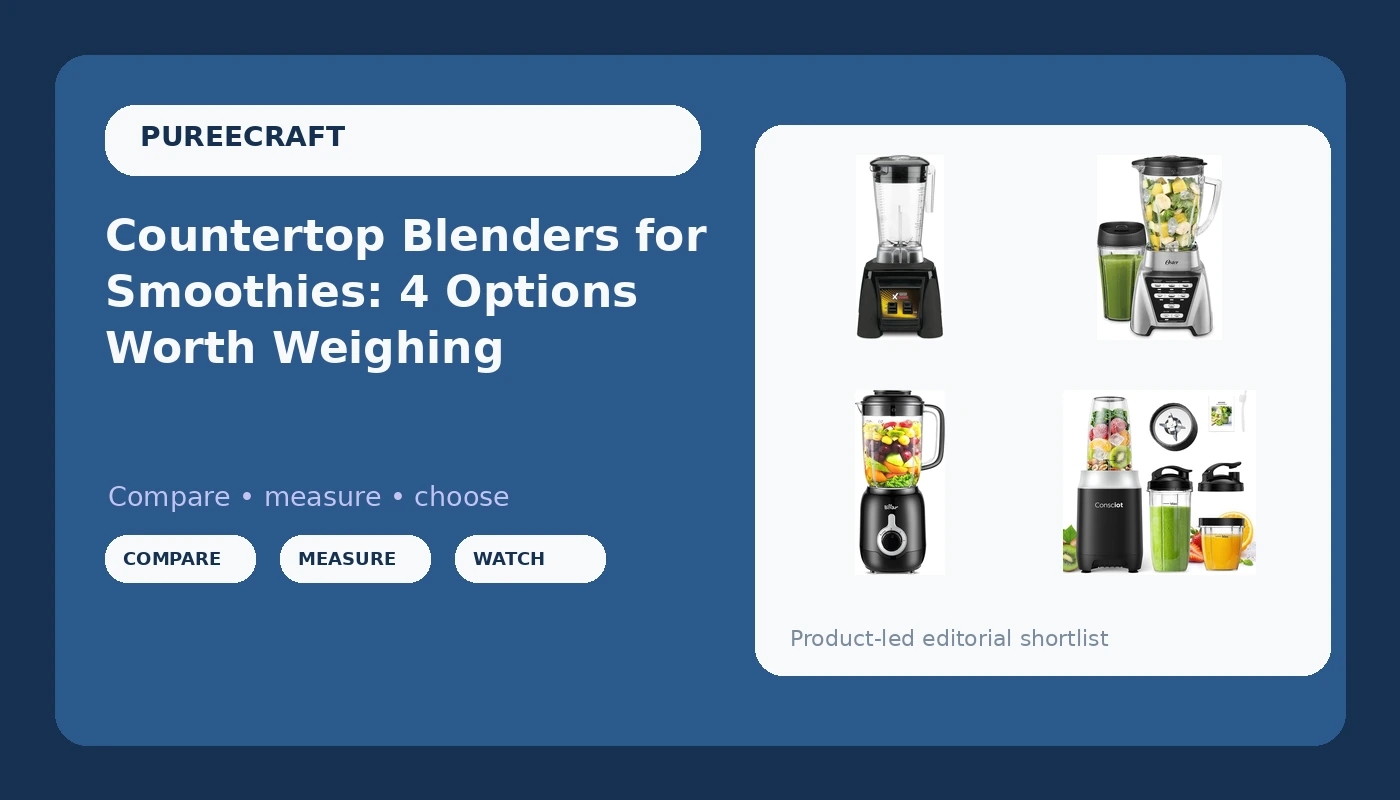
Comparing countertop blenders for smoothies is harder than it should be, because the numbers on the box are not measured the same way. A machine rated at 900 peak watts and a machine rated at 3.5 horsepower are describing two different things, and neither figure tells you whether frozen mango will come out smooth or whether kale will leave strings in your cup. What actually decides the result is the combination of motor type, blade geometry, jar shape, and how much of the food the jar pulls back down into the blade path. This explainer walks through four machines at very different points on the price and capability scale, what each one is built for, and the questions worth answering before you commit to one.
Related: Glass vs Plastic Blender Jars: What Lasts →
Quick answer
There is no single best blender for every kitchen. The four machines here split along three lines: a commercial-oriented 3.5 HP unit with a 64 oz copolyester container, a 1200W glass-jar blender that includes a 24 oz to-go cup, a compact 700W model with one 40 oz cup and a self-clean cycle, and a 900 peak-watt 11-piece kit that covers both personal cups and a full-size jar. Match the container format, jar material, and control style to your actual routine, then check current Amazon price on the listing you are considering.
Four useful options
| Model | Best fit | What stands out |
|---|---|---|
| Waring Commercial MX1000XTX | High-volume blending in a commercial or serious home kitchen | 3.5 HP motor, paddle switches with pulse, 64 oz BPA-free copolyester container |
| Oster Pro 1200 | All-purpose countertop blending with a glass jar | 1200W motor, 7 speeds, glass jar plus a 24 oz to-go cup |
| Bear Blender | Small kitchens and single-serve smoothies | 700W motor, 40 oz cup, 3 speeds, autonomous clean |
| Consciot CB10 | Buyers who want personal cups and a full-size jar in one kit | 900 peak watts, 11-piece personal and countertop combo |
Commercial workhorse: Waring Commercial MX1000XTX 3.5 HP Blender
Horsepower ratings on commercial blenders are a different scale from the peak-watt labels used on household machines, which is why a 3.5 HP figure cannot be compared directly to a 1200W number. What the rating does tell you is that this machine is designed for sustained work rather than a single morning smoothie. Paddle switches are also worth noting for anyone who has fought with touch panels that stop responding when the jar sweats: physical switches do not care about moisture. The trade-offs are the size of the footprint, the price bracket, and the plug type, which is not the standard household configuration you would find on a typical countertop model.
Glass-jar all-rounder: Oster Pro 1200 Smoothie Blender
Glass jars are heavier than plastic or copolyester, and that weight is the point: glass resists scratching and staining from turmeric, beet, and berry blends in a way that clear plastic eventually does not. Scratched plastic is also harder to judge visually, since you cannot easily tell a surface scuff from residue. Seven speeds give you more room to step down for softer ingredients instead of running everything at maximum. The included 24 oz to-go cup covers the single-smoothie case without asking you to pour from a full-size jar.
Compact smoothie pick: Bear Blender 700W
Fewer speeds is not automatically a downgrade. Three settings cover the common cases: crushing ice, pureeing, and handling frozen fruit. What you give up is fine-grained control for recipes that want a slow ramp, and what you gain is a simpler decision every morning. The self-clean cycle matters more than it sounds, because the most common reason a blender stops getting used is the cleanup routine, not the motor. A 40 oz cup also sits in a useful middle zone: large enough for a two-person batch, small enough to store without dedicating cabinet real estate.
Personal and full-size combo: Consciot CB10
The phrase to read carefully here is "peak watts." Peak wattage describes a short maximum draw, not the sustained output a motor holds under a full jar of frozen fruit, so a 900 peak-watt rating is not the same claim as a continuous rating. That does not make the number meaningless, it just means it should be read as one data point rather than a verdict. The 11-piece count is the real differentiator: one base, two workflows, which suits households where one person wants a single-serve cup and someone else wants to blend for a crowd.
Prices and availability may change. Product images, names, and retailer links are matched to verified listings. No current price, rating, stock status, or measured result is stated here without current evidence.
What wattage ratings actually tell you
Wattage is a starting point, not a verdict. The three ratings in this lineup illustrate why. The Oster lists 1200W, the Consciot lists 900 peak watts, and the Bear lists 700W, and those figures are not directly interchangeable. Peak wattage measures a brief maximum draw, while a plain wattage figure may describe running draw or something closer to peak depending on the brand. Horsepower, used by the Waring, is a third scale entirely.
What the number cannot tell you is how well the jar feeds ingredients into the blades. A motor can be genuinely powerful and still leave chunks if the jar shape lets frozen fruit spin in a pocket above the blade instead of dropping into it. That is why two blenders with similar ratings can perform very differently on the same frozen mango, and why the container design deserves as much attention as the spec sheet. Read wattage as a rough indicator of how much work the motor is built to survive, then look at jar geometry and blade design for how well the blend will actually go.
Jar material, blade geometry, and the tamper question
Jar material affects both durability and daily habits. Glass resists scratching and staining and is easy to inspect for cleanliness, but it is heavy and you handle it carefully. Copolyester, used in the Waring's 64 oz container, is lighter and designed for commercial handling. Clear plastic is the lightest option and typically the first to show scratches and cloudiness. A jar you avoid using because it is annoying to clean is a jar that stops earning its counter space.
Blade geometry is the part nobody puts on the box. Blades that sweep at multiple heights and angles keep food moving rather than letting it settle into a single spinning pocket. On thick blends, like nut butter or a low-liquid smoothie, the limiting factor is usually not motor power but whether the mixture can be pushed back into the blade path. A tamper is the standard tool for that job on machines designed to accept one, and it is worth checking whether the model you are considering supports one before you commit to thick blends.
- Decide the container format first: single-serve cup, mid-size 40 oz cup, or a full-size 64 oz jar.
- Decide the jar material: glass for scratch resistance, copolyester for commercial-grade durability, plastic for lightest weight.
- Check the control style: physical paddle switches and pulse versus touch panels and preset programs.
- Confirm the power configuration, including plug type, matches your kitchen outlet before buying.
- Set your thickness ceiling: if you plan to blend nut butter or very low-liquid mixtures, verify the machine supports the technique you intend to use.
Practical guidance for smoothie blending at home
- Load liquids first, then soft ingredients, then frozen fruit and ice on top, so the blade path stays clear.
- Cut frozen fruit into smaller pieces before blending; large frozen blocks stall any motor regardless of its rating.
- Use pulse for chopping and texture control, and reserve continuous high speed for breaking down ice and frozen fruit.
- Rinse immediately after pouring. Residue that dries on the jar wall takes far more effort than a thirty-second rinse.
- Store the jar and cup assembled and within reach, because a blender kept in a cabinet is a blender that gets skipped.
Which option should you choose?
Choose the Waring Commercial MX1000XTX 3.5 HP Blender when you blend in volume, want paddle switches and a pulse function, and can accommodate a commercial-oriented 120V plug configuration. Choose the Oster Pro 1200 Smoothie Blender when you want a glass jar, seven speeds of control, and a 24 oz to-go cup for single servings. Choose the Bear Blender when counter space is tight and you want one 40 oz cup with a self-clean cycle and three straightforward speeds. Choose the Consciot CB10 when you want both personal cups and a full-size jar from a single base, and you understand that its 900 figure is a peak rating.
A caveat on all four: the details above come from the product listings, not from independent measurement. Wattage, capacity, and included accessories are stated as the manufacturer describes them. Anything beyond that, including how a specific machine handles your exact frozen fruit ratio, depends on technique and ingredients as much as hardware.
The bottom line
The right countertop blender for smoothies is the one whose container format, jar material, and controls match how you actually blend. If you need volume and commercial-grade construction, the Waring MX1000XTX is built for that class of work. If you want a glass jar with a to-go cup and more speed settings, the Oster Pro 1200 covers the standard countertop role. If you want a compact single-cup machine with a self-clean cycle, the Bear Blender fits that job, and if you want two formats from one base, the Consciot CB10 delivers both. Check current Amazon price on each listing, since prices and availability change.