Every blender box leads with a number, and the number is almost always watts. Walk the aisle and you will see 1,400 watts, 1,380 watts, 3.5 horsepower, 400 watts, each figure printed larger than the jar it comes attached to. After seven years running a juice and smoothie bar that pushed out 400 drinks a day, I can tell you the wattage on the box was rarely what decided which machine survived the summer and which one quit in August. Jar geometry, blade design, and whether there was a tamper in the box decided that.
Below are four countertop blenders for smoothies and ice sitting at very different points on the power and price spectrum: a 1,400-peak-watt kitchen system, a 1,380W blender that ships with a tamper, a 3.5 HP machine with a 72 oz Tritan jar, and a 400W corded immersion blender for small jobs. None of them is a commercial machine and none of them needs to be. What matters is matching the design to what you actually blend on a Tuesday morning, not to what the box shouts at you.
Related: How to Stop a Blender Jar From Cracking at the Base →
Quick answer
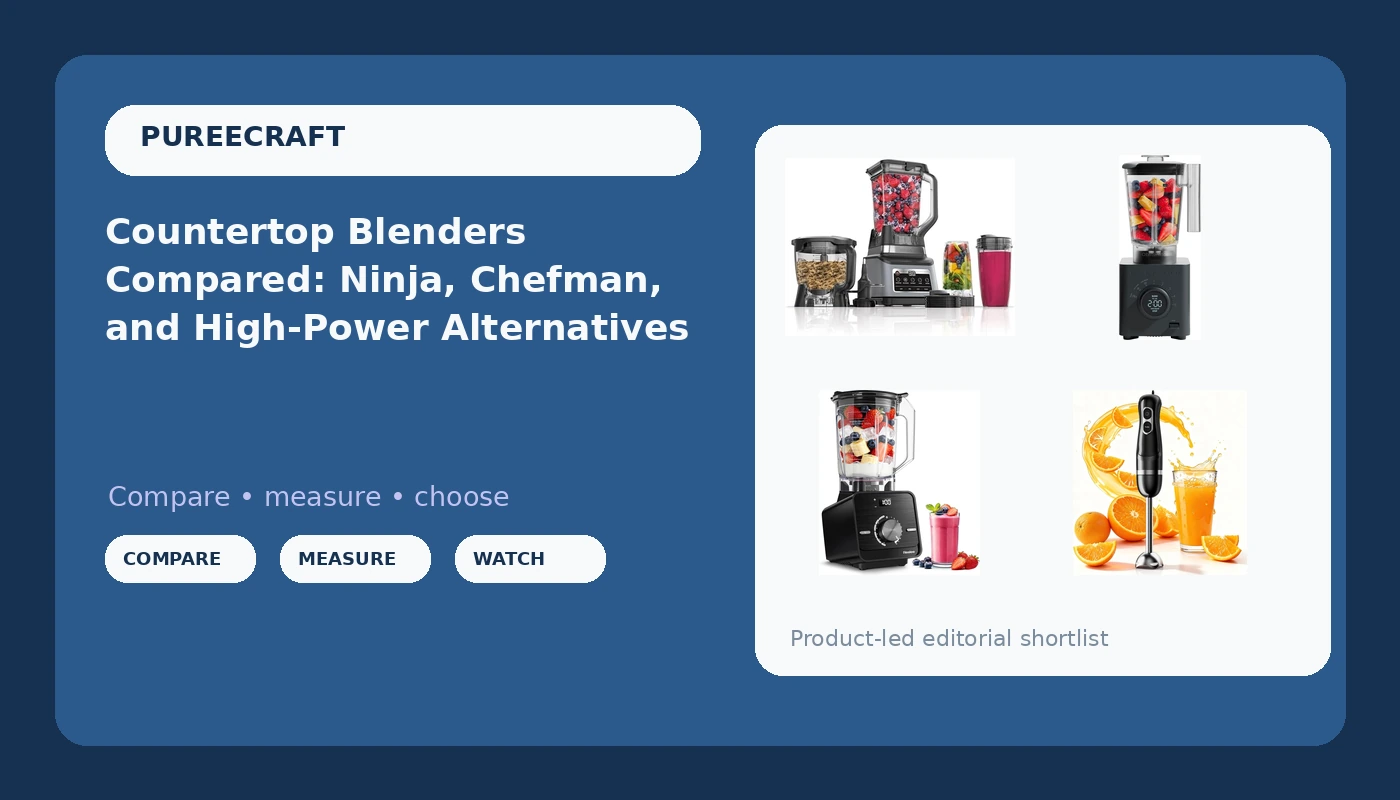
For most home kitchens the deciding factor is not wattage but whether the jar pulls thick blends down into the blades, and whether you have a tamper for the days it cannot. The Ninja Professional Plus Kitchen System covers blending and processing on one base with Auto-iQ programs and a 1,400 peak watt rating. The Chefman Obliterator ships with a tamper and scraper, which matters more than its 1,380W figure once frozen fruit and nut butter are involved. The Professional High Power Blender brings a 3.5 HP motor, 10 speeds, and a 72 oz Eastman Tritan jar for large batches, hot soup, and nut milk. The Turelar Immersion Blender is the 400W corded tool for small jobs and blending directly in a pot or cup. Buy for the hardest thing you blend every week.
Four useful options
| Model | Best fit | What stands out |
|---|---|---|
| Ninja Professional Plus Kitchen System, 1400WP, Auto-iQ, Grey, BN801 | Blending plus processing on one base | 1,400 peak watts with Auto-iQ preset programs in a kitchen system format |
| Chefman Obliterator 48 oz Countertop Blender for Smoothies, 1380W Motor to Crush Ice, Nuts, and Frozen Fruit with Stainless Steel Blade, Auto Blend Function, Includes Tamper and Scraper | Thick blends that need a tamper | 1,380W motor, 48 oz jar, stainless steel blade, tamper and scraper included |
| Professional High Power Blender, 2026 Upgraded 3.5HP Motor 30000 RPM, Heavy Duty Countertop Blender for Milkshake, Smoothie, Frozen Fruit & Ice, Hot Soup & Nut Milk, 72oz Eastman Tritan Jar, 10 Speeds | Large batches and hot blends | 3.5 HP motor rated to 30,000 RPM, 72 oz Eastman Tritan jar, 10 speeds |
| Turelar Immersion Blender Corded 400W, 2 Speed, Emulsifier, Blend, BPA-Free | Small jobs and blending in the pot | Corded 400W motor, two speeds, BPA-free shaft, emulsifying and blending |
The all-in-one base: Ninja Professional Plus Kitchen System, 1400WP, Auto-iQ, Grey, BN801
The trade-off with a system like this is that you are paying for flexibility, not for the heaviest possible blending jar. Auto-iQ programs remove the guesswork from a smoothie or a frozen drink, which is genuinely useful at 6 a.m. when you do not want to stand there pulsing by feel. What they do not do is change the physics of a jar that cannot pull a thick blend down into the blade path. In my years with Ninja machines, the blade stack did the work and the jar was the part that aged first, usually at the base seal. Treat the pitcher well, do not run it through a hot dishwasher cycle if the manufacturer guidance says otherwise, and it will hold up far longer than the version that gets thrown in with the dinner plates.
The tamper-included option: Chefman Obliterator 48 oz Countertop Blender for Smoothies, 1380W Motor to Crush Ice, Nuts, and Frozen Fruit with Stainless Steel Blade, Auto Blend Function, Includes Tamper and Scraper
If you have ever stood over a blender with a spatula in one hand, scraping the sides while the motor whines at nothing, you already understand why the tamper matters. Thick blends, meaning almond butter, frozen mango with no added liquid, or a greens-heavy smoothie, form a cavity around the blades and stop circulating. A tamper lets you push that material back into the blade path while the machine runs, which is how commercial bars get a smooth texture without adding a cup of juice to thin it out. The 48 oz capacity is a moderate batch size, roughly two large smoothies, which suits a household of one or two far better than a giant jar that never gets filled. The scraper is a small thing, but it is the difference between getting all of it out and leaving a third of your nut butter on the wall.
The high-power jar: Professional High Power Blender, 2026 Upgraded 3.5HP Motor 30000 RPM, Heavy Duty Countertop Blender for Milkshake, Smoothie, Frozen Fruit & Ice, Hot Soup & Nut Milk, 72oz Eastman Tritan Jar, 10 Speeds
A 72 oz jar is a family-sized batch, which is either exactly what you need or twice what you need. If you make one smoothie at a time, a jar that size means the blades are working on a shallow pool at the bottom, and that is a harder job than a full jar. If you blend for three or four people, or you meal-prep smoothie packs for the week, the capacity earns its counter space. Tritan is the material worth noting here: it is the same family of copolyester used in a lot of commercial drinkware because it resists clouding and cracking better than basic plastic, and it does not carry the weight of glass. The hot soup and nut milk capability also changes how you use the machine, since blending warm liquids in a closed jar builds pressure. Vent the lid, fill conservatively, and start on a lower speed rather than the top setting.
Prices and availability may change. Product images, names, and retailer links must be matched by verified ASIN. Do not state a current price, rating, stock status, or measured result without current evidence.
The small-job tool: Turelar Immersion Blender Corded 400W, 2 Speed, Emulsifier, Blend, BPA-Free
An immersion blender is not a substitute for a jar blender when ice is involved, and no 400W stick is going to turn frozen mango into a smooth puree without help. What it does well is the job a jar blender does badly: pureeing soup in the pot, emulsifying a dressing in a cup, breaking down a small amount of fruit for a single serving, or blending a sauce without dirtying a pitcher and a lid. The corded design means you are not managing a battery charge, which matters if you reach for it once a week rather than daily. If your kitchen is small and your blending is mostly soft ingredients, this class of tool covers more of your cooking than a full-size machine does.
What wattage actually tells you
Peak wattage, the number on the front of most boxes, describes the highest draw the motor can hit briefly under load. It is not a continuous-duty rating, and manufacturers are not required to publish the continuous figure, so a 1,400 peak watt machine and a 1,400 continuous watt machine can behave very differently. Horsepower ratings on high-speed blenders are looser still, often describing the motor at its theoretical maximum rather than sustained output. This is why two blenders with similar numbers can feel nothing alike.
RPM and blade tip speed matter for the fine, silky texture people want from a high-speed machine, but speed alone does not move food. Torque, which is the motor's ability to keep turning when the load fights back, is what gets a frozen block of fruit through the blade path instead of stalling the motor. A jar full of frozen strawberries is a high-torque job. A jar full of liquid is a high-speed job. Very few spec sheets tell you which one you are buying.
The practical version: treat the wattage figure as a starting point for comparison within a product line, not as a verdict across brands. Then look at the things the number cannot tell you, which are the jar, the blades, and whether the machine includes a tamper.
Why jar geometry and the tamper matter
A blender jar is a funnel. Its job is to keep moving ingredients toward the blades and then circulate them back up the sides so they get hit again. A jar with the wrong taper, too wide a base, or blades set too low creates a dead zone where thick material sits still while the motor spins freely. This is the single most common reason a powerful blender produces a chunky smoothie. The motor is not failing. The jar is not feeding it.
Tampers solve the dead zone directly by letting you push material into the blade path while the machine runs. That is why commercial bars keep one within arm's reach at all times, and why a tamper-free thick-blend machine is a design compromise. If a blender cannot handle a thick blend without extra liquid, you end up drinking a thinner smoothie than you wanted, which defeats the point.
Jar material is the other long-term factor. Glass is heavy but does not scratch. Standard plastic is light and cheap but clouds and can crack at the base seal over time. Tritan sits between the two on cost and resists cracking better than basic plastic, which is why it shows up in machines meant for daily use. Whatever the material, follow the manufacturer's dishwasher guidance rather than assuming everything is safe on the bottom rack.
- Write down what you actually blend in a normal week, not what you plan to blend.
- Decide your realistic batch size, whether that is one smoothie or four.
- Decide whether thick blends are part of your routine, and if so, prioritize a tamper.
- Check the jar material and the manufacturer's dishwasher guidance before you buy.
- Match the motor rating to your hardest weekly job, and confirm the return window in case the jar and your counter do not get along.
Practical guidance for everyday blending
- Load the jar in order: liquid first, then soft ingredients, then frozen fruit and ice on top.
- Cut frozen fruit into smaller pieces so the blades bite instead of bouncing.
- Never fill past the maximum line, since a full jar of thick blend has nowhere to circulate.
- Use short pulses for chopping and the continuous setting for pureeing, rather than one long run.
- Rinse the jar immediately after use, before residue dries on the blade assembly.
- Vent the lid and start slow when blending anything warm, because heat builds pressure in a sealed jar.
Which option should you choose?
Choose the Ninja Professional Plus Kitchen System, 1400WP, Auto-iQ, Grey, BN801 when you want one base that handles blending and processing, and you like the idea of preset programs doing the timing for you. Choose the Chefman Obliterator 48 oz Countertop Blender for Smoothies, 1380W Motor to Crush Ice, Nuts, and Frozen Fruit with Stainless Steel Blade, Auto Blend Function, Includes Tamper and Scraper when thick blends are a regular part of your week and you want the tamper in the box rather than sold separately. Choose the Professional High Power Blender, 2026 Upgraded 3.5HP Motor 30000 RPM, Heavy Duty Countertop Blender for Milkshake, Smoothie, Frozen Fruit & Ice, Hot Soup & Nut Milk, 72oz Eastman Tritan Jar, 10 Speeds when you blend large batches, want the Tritan jar, and expect to make soup and nut milk as well as smoothies. Choose the Turelar Immersion Blender Corded 400W, 2 Speed, Emulsifier, Blend, BPA-Free when your blending is mostly small jobs, soft ingredients, and pureeing directly in the pot.
None of these listings publishes a continuous-duty motor rating, a noise figure, or a jar replacement price, so those comparisons cannot be made from the product pages alone. What the listings do give you is the jar size, the jar material, the motor rating, and in one case a tamper, which are the details that decide daily usability.
The bottom line
Wattage is a starting point, not a verdict. The four blenders here cover the range from a 400W corded immersion tool to a 3.5 HP machine with a 72 oz Tritan jar, and the right one depends on batch size, how thick your blends get, and whether a tamper is part of the package. If you make one smoothie a day with frozen fruit, buy for the jar and the tamper, not for the biggest number on the box. Check current Amazon price on each before deciding, and let the hardest thing you blend every week make the call.