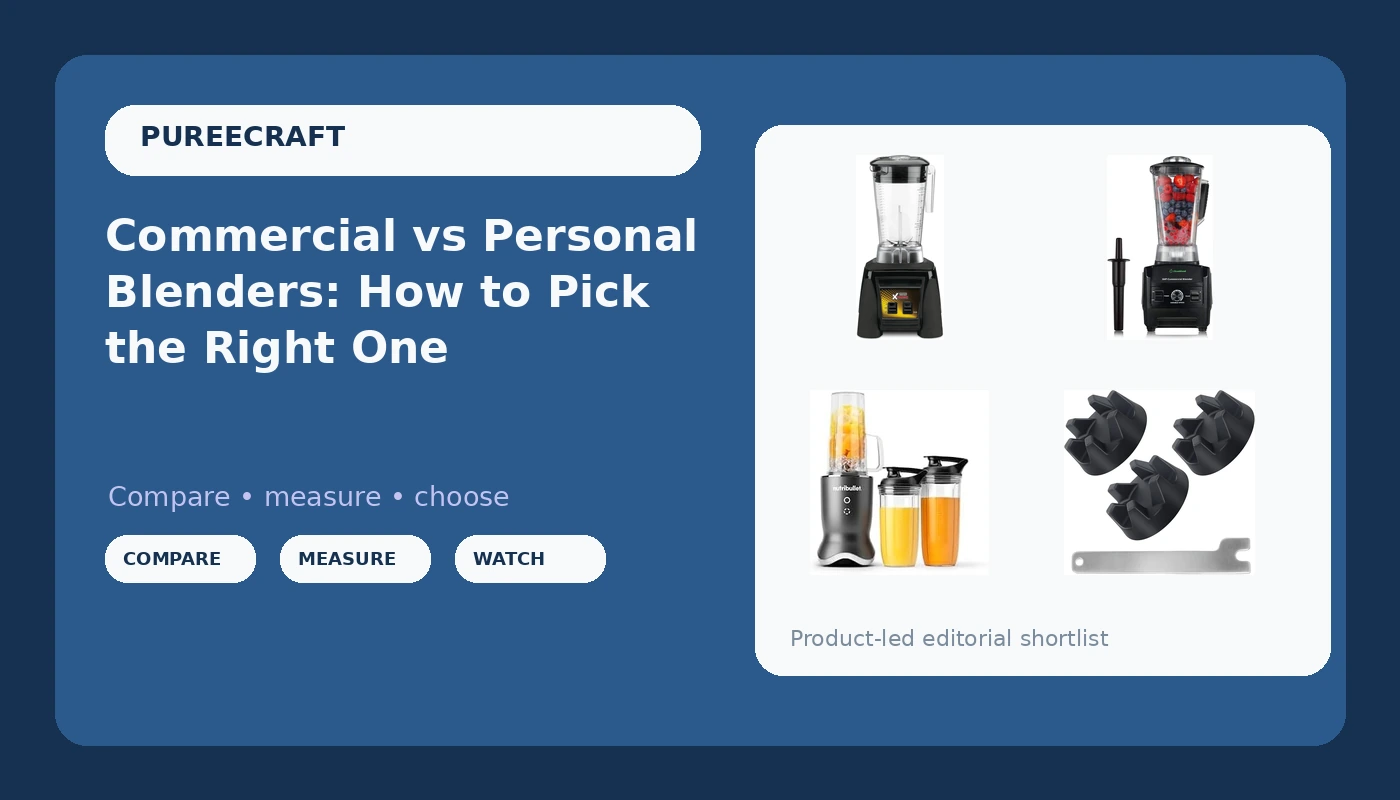
A commercial blender exists to solve one problem: running for hours, not minutes, while still pulling frozen fruit and nut butter down into the blade path instead of stalling on top of it. Most home kitchens do not have that problem. They have a smaller, more annoying one, where a machine bought for occasional smoothies either chokes on the first bag of frozen mango or costs more than the counter it sits on.
The four products below sit at very different points on that spectrum. Two are commercial-style countertop blenders, one is a personal blender, and one is a small replacement part that decides whether an existing blender keeps working at all. What matters is matching the machine to your actual volume, not to the biggest number printed on the box.
Related: Blender Jar Materials Explained →
Quick answer
For one or two single servings a day, a personal blender with dishwasher-safe cups covers most mornings and takes up almost no counter space. For daily frozen fruit, ice, nut butter, or a household of four, a commercial-style countertop blender with a 64 oz jar is the more honest purchase. If an existing KitchenAid blender hums but the blades do not turn, the coupler is usually the failed part, not the motor. Decide your volume first, then compare motors.
Four useful options
| Model | Best fit | What stands out |
|---|---|---|
| Cleanblend Commercial Blender | Daily frozen blends and nut butters at home | 1,800W motor, 3 HP rating, 64 oz container, stainless steel blades, 5-year full warranty |
| Waring Commercial MX1000XTX 3.5 HP Blender | High-volume kitchens and small cafes | 3.5 HP motor, paddle switches with pulse, 64 oz BPA-free copolyester container, 120V with 5-15 phase plug |
| nutribullet Ultra Personal Blender | One or two single servings a day | 1,200W motor, titanium coated blades, three BPA-free cups in 32 oz and 24 oz, to-go lids, dishwasher safe |
| KitchenAid Blender Coupler Replacement (9704230) | Reviving a KitchenAid KSB5WH, KSB5, or KSB3 | Direct replacement coupler for the listed models, sold as a repair part rather than a machine |
The value workhorse: Cleanblend Commercial Blender
Cleanblend's pitch is straightforward: commercial-style power at a home-kitchen price, with a 1,800W motor driving stainless steel blades inside a 64 oz container. The spec that stands out is not the wattage, it is the 5-year full warranty. On a machine that is expected to take a beating, warranty length tells you something about how the manufacturer views the duty cycle.
The trade-offs are weight and noise. A 64 oz jar full of frozen fruit is a heavy thing to lift and rinse, and nothing in this class is quiet. What you get in return is a jar large enough to blend for more than one person at a time, which is the entire point of buying a full-size machine instead of a cup.
The commercial benchmark: Waring Commercial MX1000XTX 3.5 HP Blender
The Waring is the one built for a counter that never stops. Paddle switches instead of a dial, a pulse function for short chops, a 3.5 HP motor, and a 64 oz BPA-free copolyester container. Copolyester is the material commercial kitchens favor because it handles drops and repeated dishwasher cycles far better than the thin polycarbonate on budget machines.
Two details matter before buying. First, this is a 120V unit with a 5-15 phase plug, so it runs on a standard North American wall outlet rather than a special circuit. Second, at 3.5 HP this is a great deal of machine for a household that blends twice a week. If you are not making multiple batches a day, you are paying for duty cycle you will never use.
The single-serve option: nutribullet Ultra Personal Blender
Not everyone needs a 64 oz jar. The nutribullet Ultra is a 1,200W personal blender with titanium coated blades, three BPA-free cups in 32 oz and 24 oz sizes, to-go lids, and dishwasher-safe parts. That last point matters more than it sounds. A blender you are comfortable putting in the dishwasher is a blender you will keep using, and a machine that is a hassle to clean quietly stops getting used.
The honest limitation is volume and texture. Single-serve cups are designed for one drink at a time, and personal blenders generally struggle with thick blends and large ice loads. If your routine is a protein shake and a fruit smoothie for one, this category is efficient and easy to live with. If you are blending for a family, treat it as a second machine, not the only one.
The repair part: KitchenAid Blender Coupler Replacement (9704230)
Sometimes the right purchase is not a blender at all. This coupler connects the motor base to the blade assembly on KitchenAid KSB5WH, KSB5, and KSB3 blenders, and it is a common failure point: the motor runs, the blade does not spin. Replacing a coupler costs a fraction of a new machine and keeps a working motor out of the landfill.
It is a model-specific part, so verify your blender's model number before ordering. It is not a universal fit, and it will not fix a motor that has genuinely burned out. If the base smells hot or trips a breaker, a coupler is not the answer.
Prices and availability may change. Product images, names, and retailer links must be matched by verified ASIN. Do not state a current price, rating, stock status, or measured result without current evidence.
What wattage and horsepower actually tell you
Watts and horsepower are the numbers printed largest on the box, and they are among the least useful for predicting how a blender will perform. Wattage describes power draw, not the torque delivered to the blade at low speed, which is where thick blends actually stall. Horsepower figures in consumer marketing are often peak ratings that a motor can only touch briefly.
What decides whether a blender produces a smooth result is the combination of motor torque, blade geometry, and jar shape. A jar that narrows toward the blade funnels ingredients into the blade path. A jar with a wide, flat bottom lets frozen fruit sit on top of the blades and spin in place. That is why a lower-wattage machine with good jar geometry can outperform a higher-wattage machine with poor geometry, and it is why a tamper exists on machines built for thick blends.
For reference points within this group: the Cleanblend is rated 1,800W and 3 HP, the Waring is rated 3.5 HP, and the nutribullet Ultra is rated 1,200W. Those figures tell you the intended class of each machine. They do not tell you which one handles a full jar of frozen mango best, because that depends on the jar and the blade sitting above it.
Jar geometry, blade design, and the tamper
Jar material matters as much as jar shape. Copolyester, used on the Waring container, is the commercial standard because it tolerates drops and repeated dishwasher cycles. Thin polycarbonate cracks at the base seal, and that seal is the failure point that turns a working blender into a leaky one. Stainless steel blades resist dulling over time, while titanium coatings are used to help hold an edge.
Before you buy, work through this sequence:
- Count how many servings you blend per session and how many sessions you blend per week.
- Decide whether you need a tamper for thick blends, and check whether the machine includes one.
- Check the jar material and whether the jar and lid are dishwasher safe.
- Confirm the motor base fits your counter space and your outlet, including the plug type.
- Verify the warranty length and what it actually covers, not just how many years it says.
Keeping a blender alive in a real kitchen
- Load liquids first, then soft ingredients, then frozen fruit and ice on top.
- Use pulse for chopping and for starting a thick blend, then move to a continuous speed.
- Do not run a thick blend at full speed and walk away; that is how bases overheat.
- Rinse the jar immediately after use, before residue dries onto the blade assembly.
- Inspect the coupler and jar seal periodically; both are wear items, not lifetime parts.
Which option should you choose?
Choose the Cleanblend Commercial Blender when you blend frozen fruit, ice, or nut butter most days and want a 64 oz jar with a 5-year full warranty behind it. Choose the Waring Commercial MX1000XTX 3.5 HP Blender when you are blending in volume, batch after batch, and want paddle controls, a pulse function, and a copolyester jar. Choose the nutribullet Ultra Personal Blender when your routine is one or two single servings a day and dishwasher-safe cups matter more than capacity. Choose the KitchenAid Blender Coupler Replacement when the motor on a listed KitchenAid model runs but the blades do not turn.
None of these is a universal recommendation. Capacity, noise, counter space, and your willingness to clean the jar decide more than any spec sheet does, and the right machine for a family of five is the wrong one for a studio apartment.
The bottom line
Buy for your actual volume, not for the biggest number on the box. A commercial blender earns its price in a kitchen that runs it daily; in a kitchen that runs it twice a week, a personal blender with dishwasher-safe cups will get used more often and cleaned faster. Before replacing any blender, check the inexpensive parts first. A coupler costs a fraction of a new machine and is a common reason a working motor stops turning the blade. Confirm the plug type and jar material, compare warranties honestly, and let your weekly smoothie count make the decision.