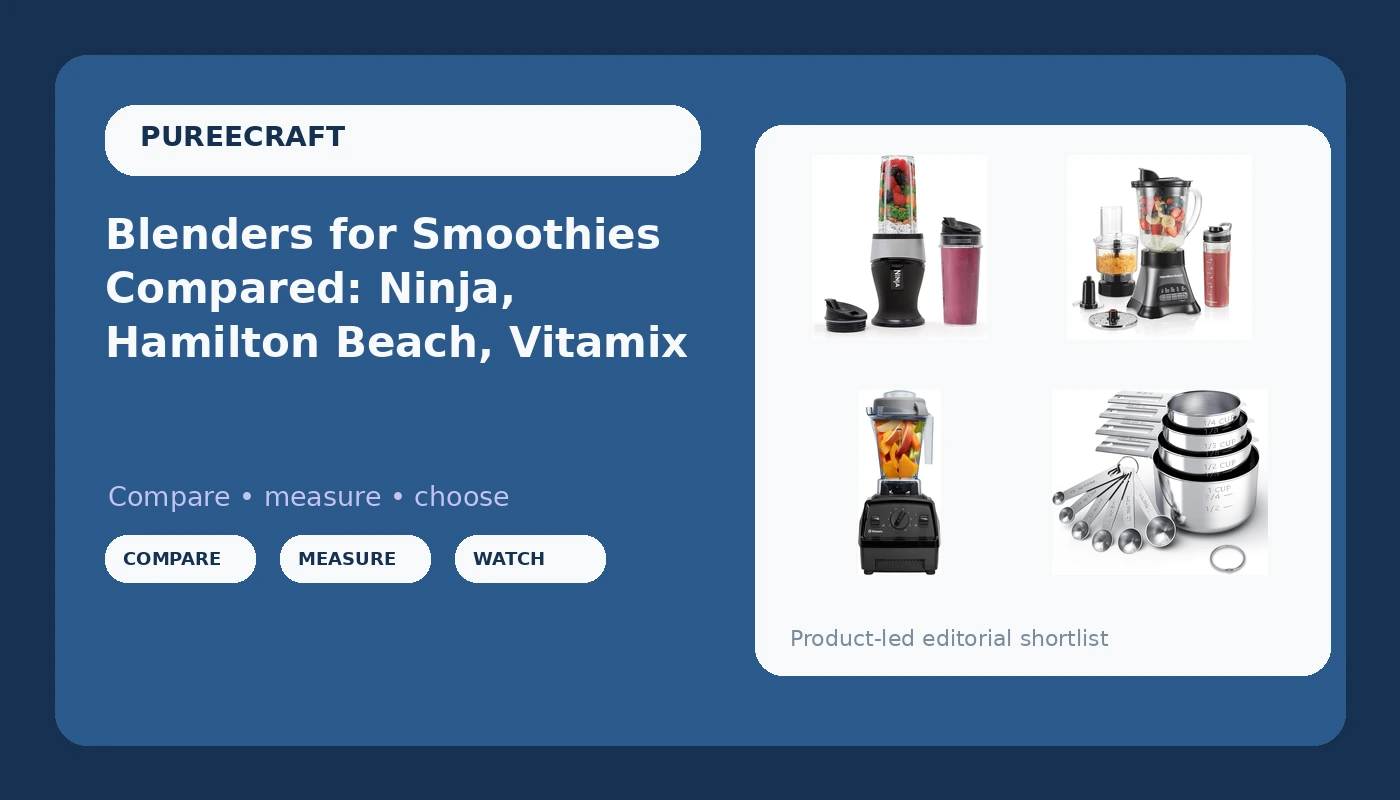
I ran a juice and smoothie bar in San Diego for seven years, and on a good Saturday we pushed about 400 smoothies through three machines before the lunch rush ended. Frozen mango, kale stems, almond butter, ice by the bucket. When I sold the shop I kept the habit and turned it into a job, testing blenders for commercial kitchen suppliers, which mostly means burning through motors so other people do not have to. This comparison of blenders for smoothies is the one I wish someone had handed me before I bought my first countertop machine, because the three blenders here sit in three genuinely different tiers, and the small stainless accessory in the group does more for consistency than any of them.
Related: Blender Jar Materials Explained: Glass Vs Plastic Vs Tritan
If I could only own one blender from this list, it would be the Vitamix E310 Explorian. If I had to buy one tomorrow on a normal household budget, it would be the Ninja Fit Compact Personal Blender. The Hamilton Beach combo is the smart pick for someone who cooks as much as they blend, and the measuring cups are the cheapest upgrade to your smoothie results in the entire group.
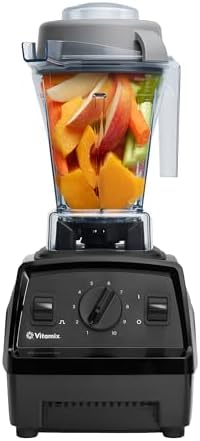
Vitamix E310 Explorian Blender
Jar geometry pulls thick blends down instead of spinning them in a pocket above the blades; 48 oz container handles a family batch; self-cleans with warm water and a drop of soap
Most expensive machine here by a wide margin; loud enough to schedule around phone calls; tall container will not clear a low upper cabinet
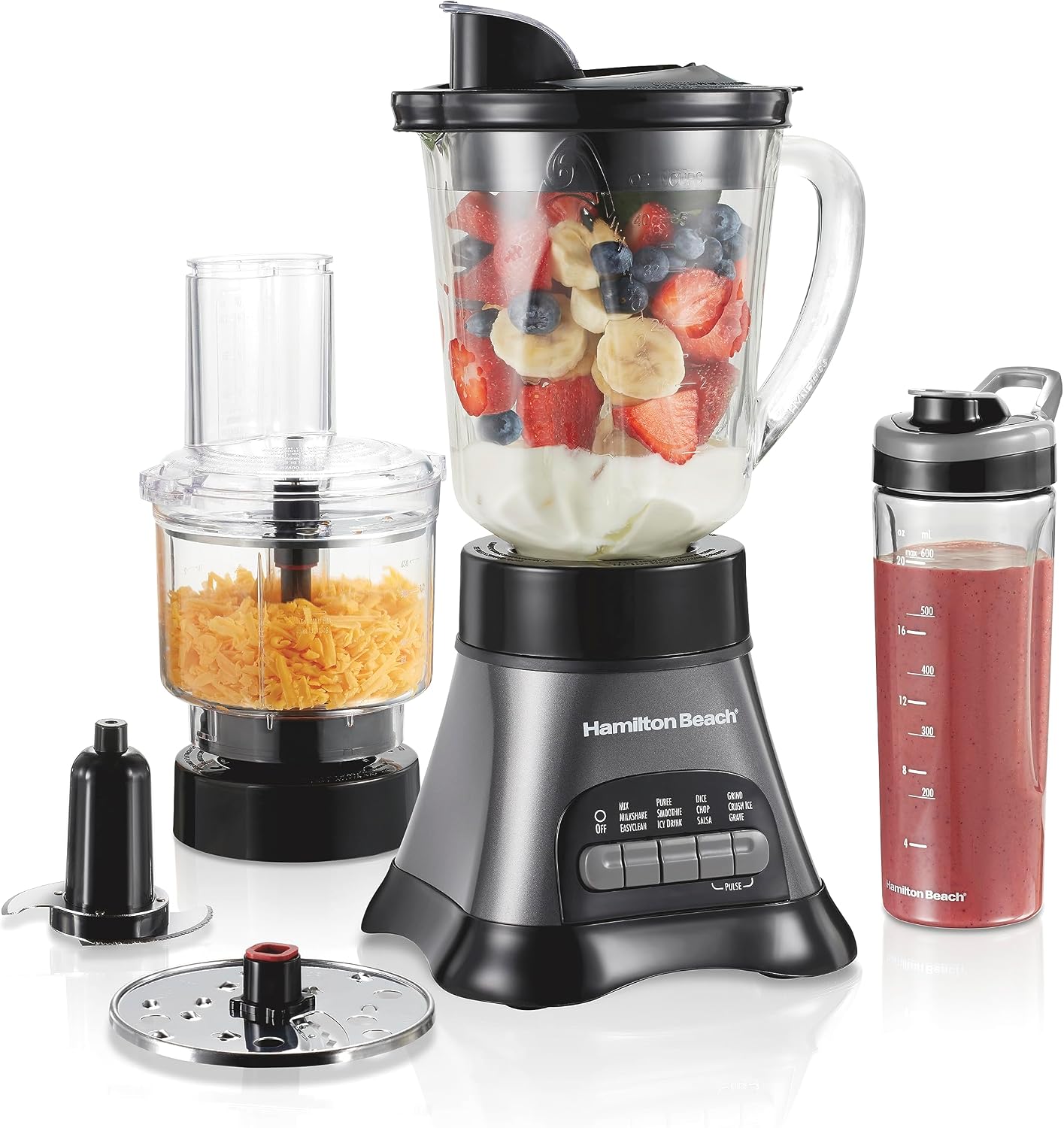
Hamilton Beach Blender and Food Processor Combo
Two appliances in one footprint; 40 oz glass jar does not stain or hold onto the smell of kale; 3 cup chopper bowl handles onions, nuts and pesto without a second machine
Peak power is not continuous power, so a full jar of frozen fruit works it hard; shallow jar needs a scrape on very thick blends; travel cup is a snack, not breakfast
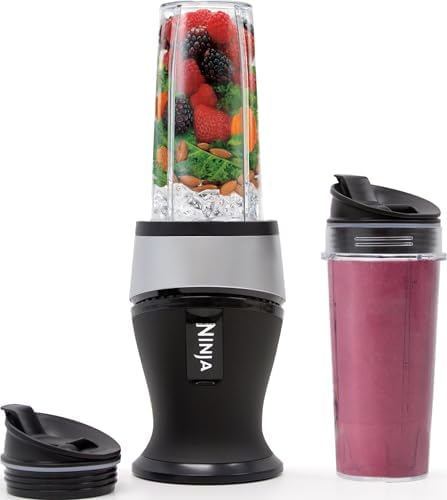
Ninja Fit Compact Personal Blender
Stacked blade design crushes ice and frozen fruit without stalling; two 16 oz cups mean one can be in the dishwasher while you drink from the other; easiest of the three to actually use daily
Plastic cups crack at the base seal; no tamper and no way to make a batch for two; nut butter strains the motor; 16 oz is one serving with no refill
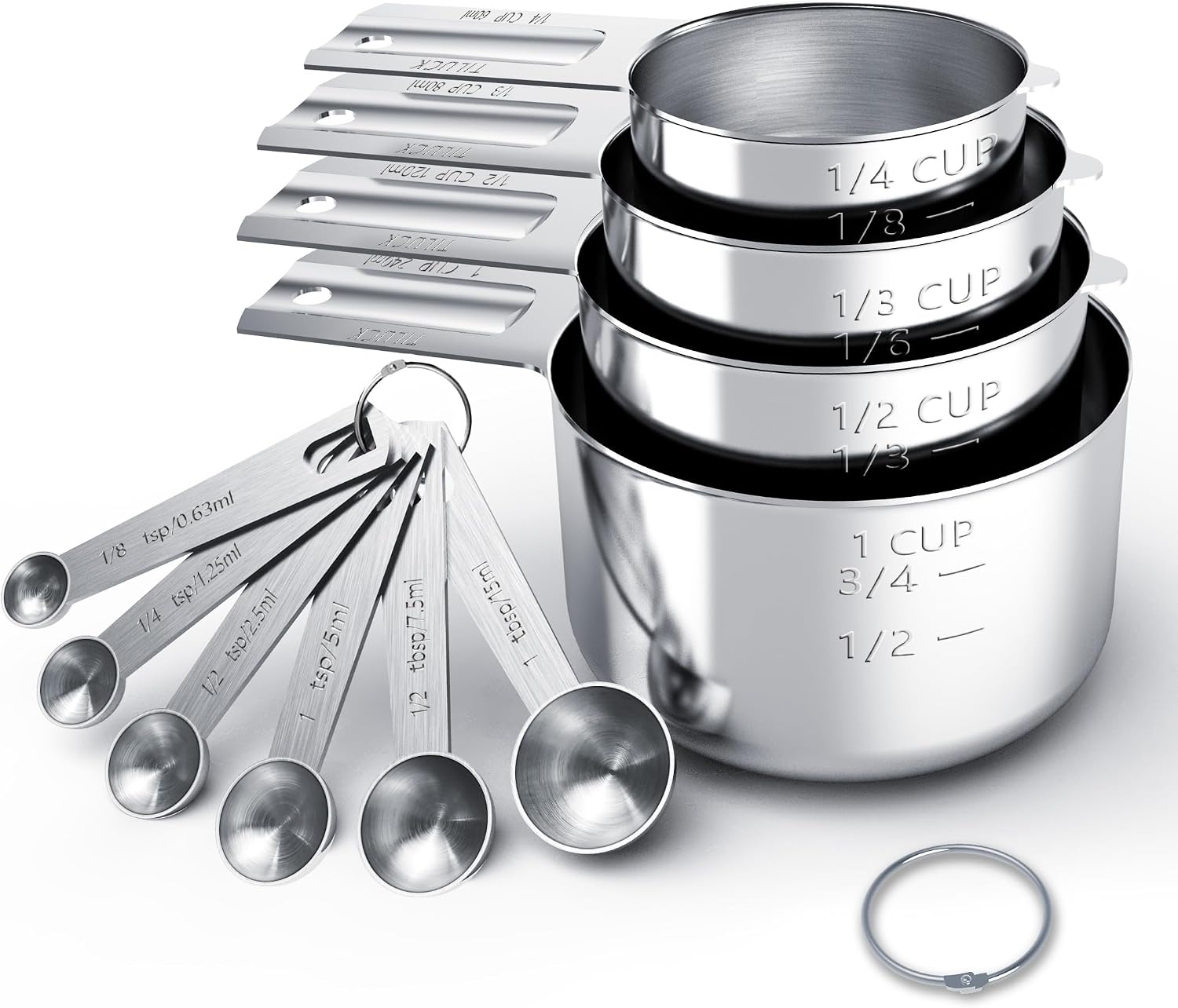
TILUCK Stainless Steel Measuring Cups & Spoons Set
Makes a smoothie recipe repeatable, which is the actual fix for inconsistent results; stainless does not stain, crack or hold onto garlic; nests flat and goes in the dishwasher
Not a blender and will not make anything smoother; handles will bend if you use the cups as an ice scoop
Prices and availability were captured from Amazon Creators API and may change.
How I judge a blender now
Seven years behind a shop counter taught me that wattage is a starting point, not a verdict. Two machines can both claim 700 watts and behave nothing alike, because blade geometry and jar shape decide whether the food actually reaches the blades. So I stopped reading spec sheets first and started running the same three checks on every unit that lands in my kitchen.
- Ice. A full tray of cubes, 30 seconds, no pulse cheating. If it comes out as snow, the machine can make a smoothie. If it comes out as gravel, it cannot, no matter what the box promises.
- Thick blends. Frozen mango, a fistful of kale stems, a spoon of almond butter. If the jar pulls the mixture down on its own, the geometry is doing its job. If I have to stop and scrape four times, the design is fighting me.
- Cleanup. Warm water, one drop of soap, 30 seconds on high. A blender you dread cleaning is a blender that ends up at the back of a cabinet.
That is the frame for everything below. None of these machines is bad. They were built for different kitchens.
The Vitamix E310 Explorian: the professional-grade pick
The E310 is the only machine here I would hand to a new juice bar without a warning speech. The 48 ounce container is the part that matters, not the motor badge. The jar tapers in a way that keeps thick blends moving toward the blades, so frozen mango and nut butter get pulled down instead of spinning in a pocket above the blade. That single design decision is why commercial kitchens pay for this class of machine.
The self-cleaning claim holds up in practice. Warm water, a drop of soap, 30 seconds on high, rinse, done. No disassembly, no scrubbing the seal with a bottle brush at 6 a.m.
What it costs you is money, noise, and counter clearance. This is the most expensive blender in the comparison and it is not close. It is loud enough that I plan blends around phone calls. And the container is tall, so measure your cabinets before you buy, because it will not slide under a low upper cabinet while it sits on the base.
The Hamilton Beach combo: the one-appliance answer
This is the machine I recommend to people with one square foot of counter space who still cook real food. The 40 ounce glass jar is the detail I keep coming back to. Glass does not stain, does not hold onto the smell of kale, and does not go cloudy after a year of green smoothies. It is heavier, which you notice when you pour, and that is the trade.
The 3 cup chopper attachment is what turns it into two appliances. Onions, garlic, pesto, nut crumbs, hummus. If you have ever made pesto in a tall blender jar and spent ten minutes scraping leaves off the walls, you already understand why a wide, short chopper bowl is a completely different job.
Here is the honest catch. The 700 watts on the label is peak power, not continuous power. Under a full jar of frozen fruit this machine works harder than the Vitamix, and you will hear it working. The jar is also shallow relative to its width, so the thickest blends need a scrape or two. And the travel cup is small enough that it is a snack, not a meal replacement.
The Ninja Fit: the single-serve workhorse
This is the one I actually use most mornings, and I say that as someone who preaches against single-serve cups. The blade stack is the reason it works. Ninja puts multiple levels of blades on one shaft, so the top of the cup is not just sitting there while the bottom spins. Frozen fruit and ice go down without the motor stalling, which I cannot say for most personal blenders in this tier.
The two cups matter more than people expect. One can be in the dishwasher while the other holds your smoothie. That is the whole reason small machines get used and full pitchers do not.
The trade-offs are real. The cups are plastic, and plastic cups crack at the base seal. That is the failure point, and it is a when, not an if, if you are rough with them. There is no tamper, and there is no way to make a batch for two people without blending twice. Nut butter will strain this motor, so I do almond butter in the Vitamix, not here. And 16 ounces is one serving with no refill.
The measuring cups that make any of this repeatable
This is the odd one out in a blender comparison, and I put it here on purpose. Most people who tell me their smoothies are inconsistent are not measuring anything. A handful of spinach, some frozen fruit, a scoop of protein. Then they wonder why Monday was good and Wednesday was chalky.
The TILUCK set fixes that. Stainless steel does not hold onto the smell of garlic, does not crack, and does not flex when you are packing brown sugar or scooping almond butter. The cups nest, the spoons nest, and the whole thing goes in the dishwasher. If you are dialing in a recipe you actually want to repeat, this is the cheapest tool in this article.
One warning: do not use the cups to scoop frozen fruit out of a bag. The handles will bend. They are measuring tools, not ice scoops.
The trade-offs, side by side
Three real trade-offs run through this whole group.
Capacity against use frequency. The 48 ounce Vitamix makes a batch for the family, but you will not haul it out for one smoothie on a Wednesday. The Ninja Fit makes one serving and you will use it every single day. The machine you use beats the machine you admire.
Jar material against weight. Glass does not stain and cleans up honestly, but it is heavy and it can break. Plastic is light and it cracks. There is no version of this where you get both.
Peak power against continuous power. The numbers on a box describe a moment. A motor's real reputation gets built at minute three of frozen fruit, when the ice is still chunky and the kale stems have not given up yet.
Which one should you actually buy
- Buy the Vitamix E310 if you blend daily, you make nut butter or thick blends, you want one machine to last a decade, and the price does not scare you.
- Buy the Hamilton Beach combo if you cook as much as you blend, you want one appliance doing two jobs, and you want a glass jar that will not stain.
- Buy the Ninja Fit if you make one smoothie a day, you want it fast, and you want something cheap enough to replace without a second thought.
- Buy the TILUCK measuring cups if your smoothies are inconsistent and you have never actually measured anything.
What I am testing next
There are two more machines on my counter this month, both marketed hard on wattage, and I am running them through the same three checks before I write a word about them. The pattern I expect, and the pattern I see every year, is that the machine with the biggest number on the box is rarely the one that pulls a thick blend down on its own.
If you take one thing from this comparison, take the ice test. Buy the machine that turns a tray of cubes into snow, keep your frozen fruit in the freezer, and measure your ingredients with something that does not lie to you. That combination beats an expensive motor every time.